Airplane plant care are popular houseplants because they grow quickly, produce attractive arching leaves, and can develop small plantlets on long stems.
Their forgiving nature makes them suitable for beginners, but even an easy plant can develop brown tips, yellow leaves, weak growth, or root problems when its basic needs are misunderstood.
The biggest mistake with airplane plant care is usually treating the plant as if it needs constant moisture. Spider plants have thick, fleshy roots that can hold water, so repeatedly watering already-moist soil can cause more problems than occasional dryness.
Once you understand how light, watering, soil, temperature, and feeding work together, keeping an airplane plant healthy becomes much easier.
Quick Answer
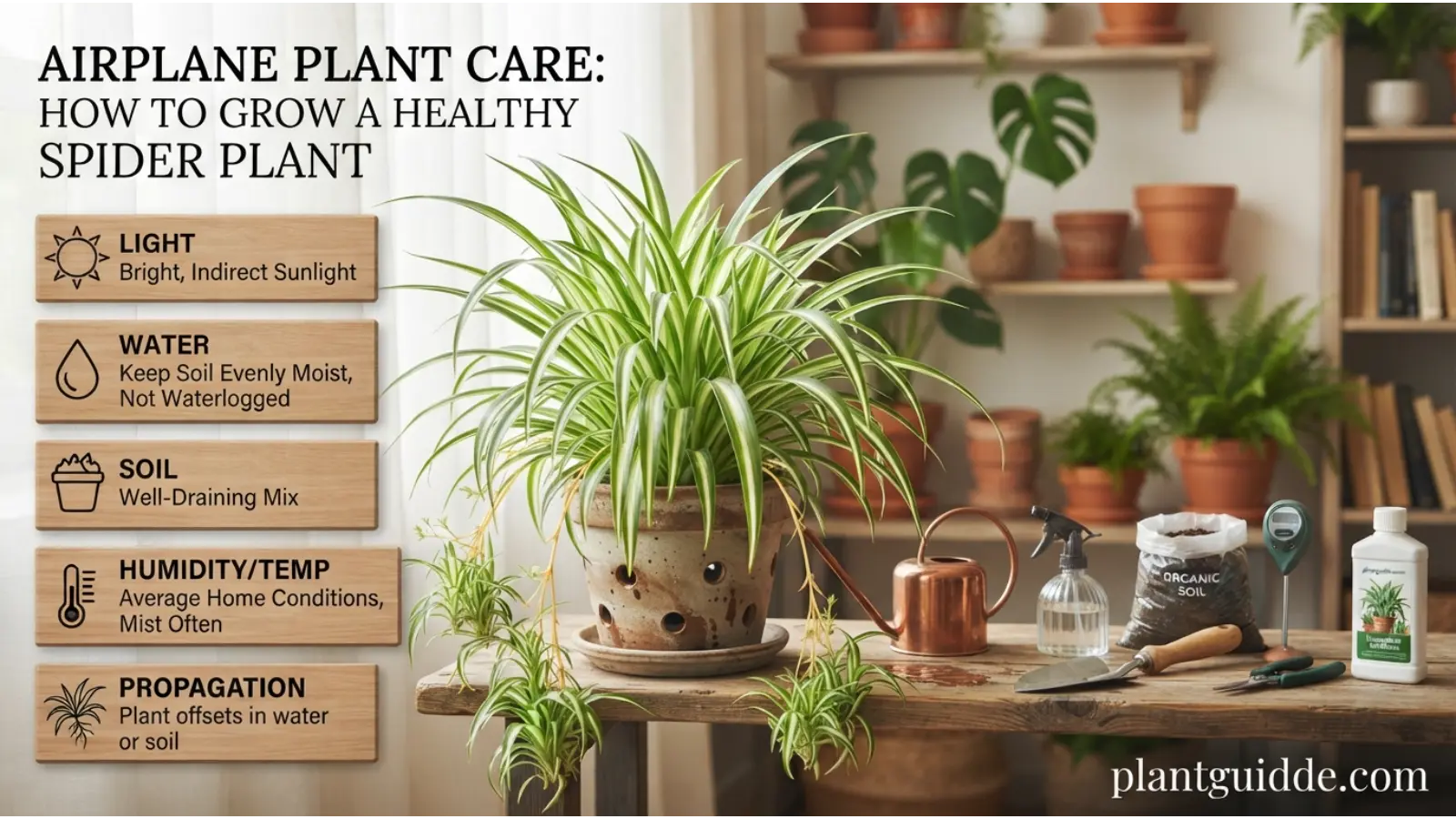
Airplane plant care is simple when you provide bright, indirect light, well-draining soil, moderate watering, and average household humidity.
Also called the spider plant (Chlorophytum comosum), it prefers to dry slightly between waterings rather than remain constantly wet. Feed lightly during active growth and remove brown or damaged leaves to keep the plant attractive and healthy.
What Is an Airplane Plant?
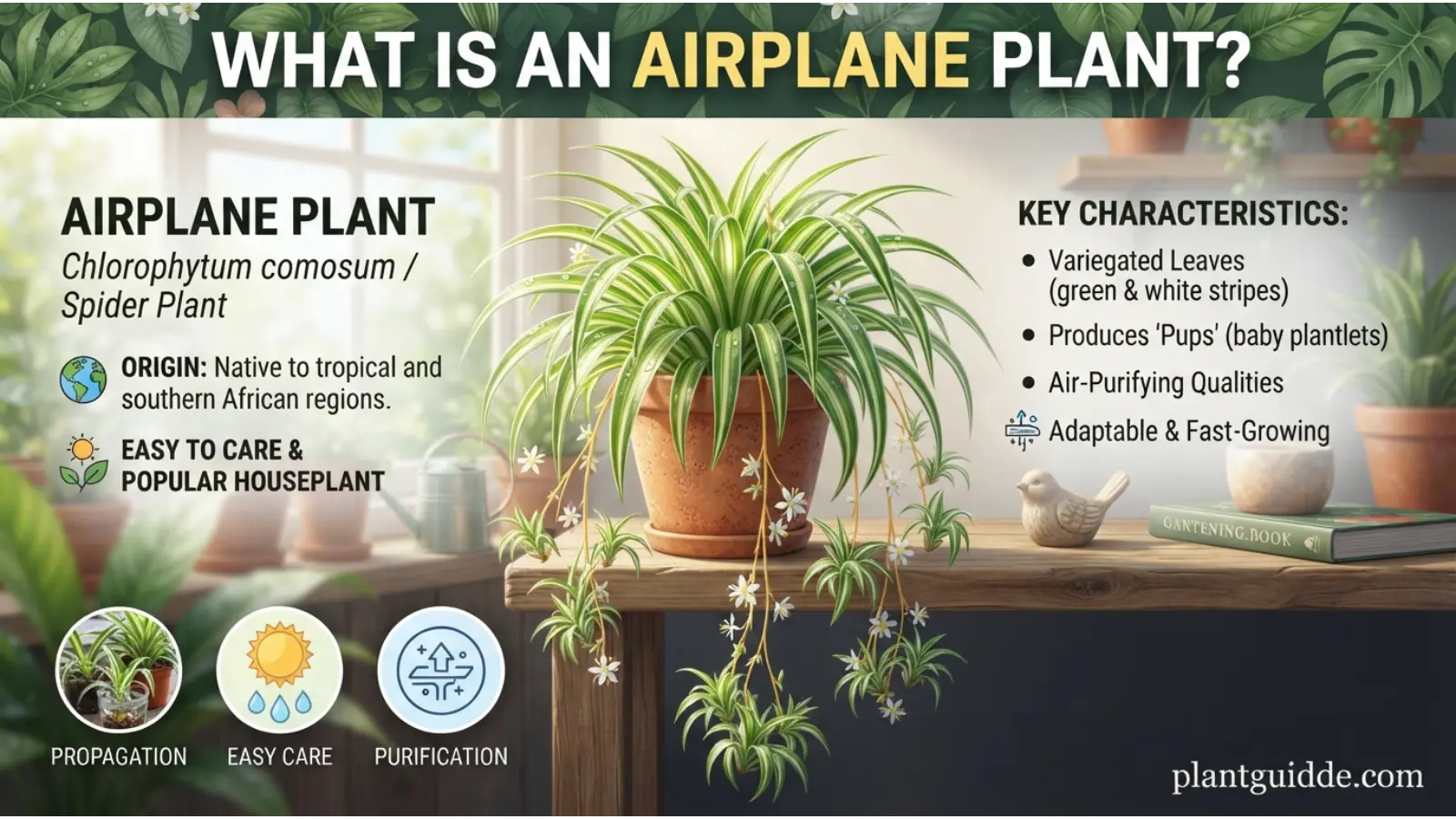
The airplane plant is commonly known as the spider plant, with the botanical name Chlorophytum comosum. It is a grass-like perennial commonly grown indoors for its long, narrow leaves and cascading growth habit.
The name “airplane plant” is often associated with the small plantlets that form on long arching stems. As these offsets develop, they can make the plant look as though small plants are flying away from the mother plant.
Depending on the cultivar, the foliage may be entirely green or striped with white or cream. Mature plants can also produce small, star-shaped flowers before developing plantlets.
This combination of attractive foliage, fast growth, and easy propagation makes the airplane plant particularly useful for hanging baskets, shelves, and bright indoor spaces.
How Much Light Does an Airplane Plant Need?
Airplane plants grow best in bright, indirect light. They can tolerate lower-light conditions, but growth may become slower and variegated leaves can lose some of their attractive striping.
A good location is near an east- or north-facing window, or slightly back from a brighter south- or west-facing window where intense sunlight is filtered.
Direct afternoon sunlight can be harsh, especially through glass. Too much strong sun may cause:
- Pale or bleached foliage
- Brown or scorched patches
- Crispy leaf edges
- Faded variegation
On the other hand, extremely low light can result in slow growth and fewer plantlets.
Practical tip: If the plant is growing slowly but its leaves remain firm and healthy, gradually move it closer to a source of bright filtered light rather than immediately placing it in intense direct sun.
How Often Should You Water an Airplane Plant?
Water an airplane plant when the top layer of soil has dried, rather than following a strict calendar schedule.
The exact interval depends on pot size, soil, temperature, humidity, season, and light. A plant in bright light during warm weather may need water much more often than one growing in a cool, dim room.
When watering:
- Check the top inch or two of soil with your finger.
- If it still feels noticeably moist, wait a little longer.
- When the surface has dried, water thoroughly.
- Allow excess water to drain from the bottom of the pot.
- Empty standing water from a saucer or cachepot.
Avoid giving small amounts of water every few days. This can leave some areas of the root zone consistently damp while other parts remain relatively dry.
Why Overwatering Causes Problems
Spider plants have fleshy roots that store moisture. Constantly wet soil reduces the air available around the roots and can encourage root deterioration.
Signs that watering may be excessive include:
- Yellowing leaves
- Soft or collapsing foliage
- Persistently wet soil
- A sour or unpleasant soil smell
- Dark, damaged roots
If the plant repeatedly develops these symptoms, changing the watering routine alone may not be enough. Inspect the roots and evaluate whether the container and soil provide adequate drainage.
What Soil Is Best for an Airplane Plant?
Use a loose, well-draining indoor potting mix that retains some moisture without becoming soggy.
A practical mix can contain:
- Quality indoor potting soil
- Perlite or pumice for extra drainage
- A small amount of orchid bark or another coarse material if the mix is dense
The goal is not to make the soil dry extremely quickly. The roots still need access to moisture. Instead, you want a balance where water can move through the root zone and excess moisture can escape.
A container with drainage holes is equally important. Even excellent soil can become problematic when excess water has nowhere to go.
What Temperature and Humidity Does an Airplane Plant Prefer?
Average indoor temperatures are generally suitable for airplane plants. Keep them away from cold drafts, heating vents, air-conditioning outlets, and sudden temperature changes.
They can handle ordinary household humidity, so you usually do not need to create a tropical environment.
If your home is particularly dry, especially during winter, you may notice more brown tips. Increasing humidity can help, but brown tips are not always caused by dry air.
Other factors include:
- Inconsistent watering
- Excess fertilizer salts
- Fluoride or mineral accumulation in water
- Root stress
- Excessive sunlight
Instead of immediately buying a humidifier, look at the plant’s overall growing conditions.
How to Fertilize an Airplane Plant
Airplane plants benefit from light feeding during periods of active growth.
Use a balanced houseplant fertilizer according to the product’s directions. Avoid repeatedly applying more fertilizer than recommended because excess salts can accumulate in the soil and contribute to brown leaf tips.
A simple approach is to fertilize during active growth and reduce or stop feeding when the plant’s growth naturally slows.
If the plant is already struggling with damaged roots, severe leaf browning, or chronically wet soil, correct those problems before adding fertilizer.
More fertilizer does not compensate for poor light, bad drainage, or improper watering.
When and How to Repot an Airplane Plant
Airplane plants can become crowded in their containers as their roots and offsets develop. Repot when roots are tightly packed, water runs through the pot unusually quickly, or growth appears restricted despite good care.
Choose a container only slightly larger than the current one. Moving a small plant into a very large pot can leave a large volume of soil wet for too long after watering.
When repotting:
- Gently remove the plant from its container.
- Examine the roots for damage or decay.
- Remove obviously dead or severely damaged roots with clean tools.
- Place the plant in fresh, well-draining potting mix.
- Keep the crown at approximately the same depth as before.
- Water thoroughly and allow excess water to drain.
Repotting is also a good opportunity to check whether the existing soil has become compacted or is holding too much moisture.
How to Propagate an Airplane Plant
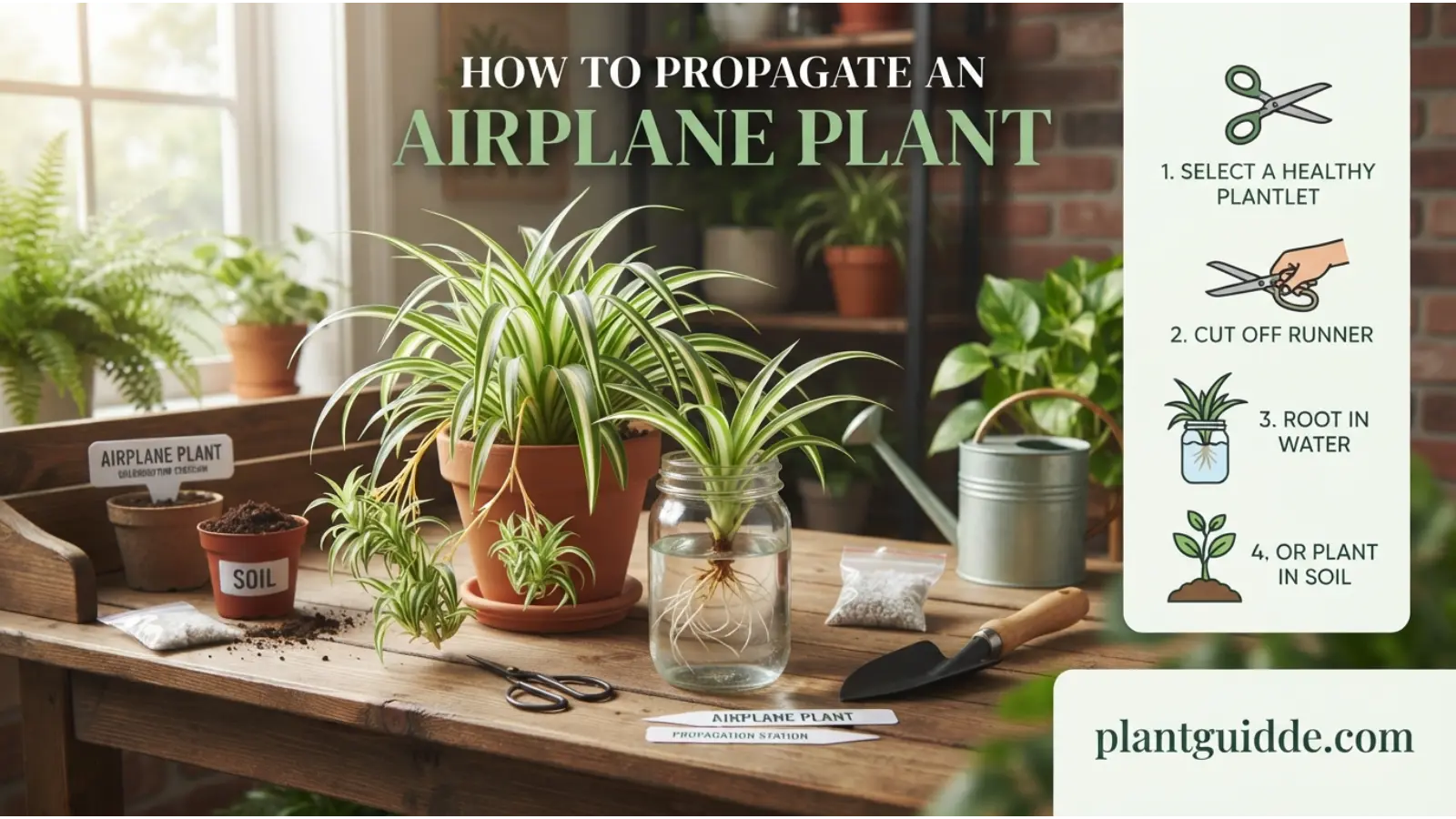
One of the easiest features of an airplane plant is its ability to produce plantlets, sometimes called spiderettes.
When mature plants produce long arching stems with small plantlets, you have several propagation options.
Propagating Plantlets in Water
Place the base of a healthy plantlet in water while keeping the foliage above the water. Once roots develop, transfer it into a well-draining potting mix.
Rooting Plantlets Directly in Soil
You can also place the plantlet onto moist potting mix while it is still attached to the mother plant. Once it establishes roots, the connecting stem can be cut.
This method can reduce transplant stress because the developing plantlet continues receiving support from the mother plant while roots form.
Tip: Choose healthy plantlets with visible root development when possible. Very small offsets may establish more slowly.
Why Are My Airplane Plant Leaves Turning Brown?
Brown tips are one of the most common concerns with spider plant care.
A few brown tips do not necessarily mean the entire plant is unhealthy. Older leaves naturally decline, and minor tip damage can occur even when the plant is otherwise growing well.
Possible causes include:
- Very dry conditions
- Irregular watering
- Excess fertilizer salts
- Mineral-heavy water
- Fluoride sensitivity
- Too much direct sunlight
- Root stress
Instead of simply cutting off the brown parts and ignoring the cause, examine the growing conditions.
If the soil is frequently bone-dry and the plant is exposed to strong sun, adjust those conditions. If the soil stays wet for long periods, investigate drainage and root health instead.
You can trim unattractive brown tips with clean scissors, following the natural shape of the leaf.
Why Is My Airplane Plant Turning Yellow?
Yellow leaves can have several causes, so the pattern matters.
If lower leaves gradually turn yellow as the plant produces new growth, some natural aging may be occurring. But widespread yellowing is more concerning.
Common possibilities include:
- Overwatering
- Poor drainage
- Root problems
- Insufficient light
- Nutrient imbalance
- Environmental stress
Check the soil before watering again. If it remains wet for an unusually long time, focus on drainage and root health rather than simply changing the fertilizer.
Why Is My Airplane Plant Drooping?
Drooping can occur when the plant is thirsty, stressed by excessive moisture, exposed to temperature changes, or dealing with root damage.
Start by checking the soil.
Dry soil + drooping leaves: The plant may need water.
Wet soil + drooping leaves: Do not automatically add more water. The roots may be stressed by excessive moisture.
This distinction is important because treating every drooping plant with more water can make an already-wet root system worse.
Why Is My Airplane Plant Not Producing Plantlets?
A healthy airplane plant may produce offsets when it is mature and growing under suitable conditions, but plantlet production is not something you should force with excessive fertilizer or frequent watering.
If your plant has plenty of foliage but no babies, review:
- Light levels
- Overall plant maturity
- Seasonal growth
- Root health
- General growing conditions
A plant that is surviving in very low light may remain alive but lack the energy for vigorous growth and propagation.
Bright, indirect light and stable care are usually more useful than trying to manipulate watering or fertilizer.
Common Airplane Plant Care Mistakes
Even though spider plants are forgiving, several common mistakes can gradually weaken them.
Watering on a Fixed Schedule
Watering every Sunday regardless of soil moisture can lead to overwatering in cool or low-light conditions.
Better approach: Check the soil before watering.
Using a Pot Without Drainage
Decorative containers without drainage holes can trap excess water around the roots.
Better approach: Use a nursery pot with drainage holes inside the decorative container.
Giving Too Much Direct Sun
A bright window does not always mean the plant should sit directly against the glass.
Better approach: Provide bright filtered or indirect light and watch for bleaching or scorch.
Overfertilizing Brown Tips
Brown tips are not automatically a sign that the plant needs more nutrients.
Better approach: Consider water quality, moisture, light, and fertilizer accumulation together.
Ignoring Crowded Roots
A severely root-bound plant may struggle even when its light and watering routine seem correct.
Better approach: Inspect the root system when water runs through unusually quickly or growth becomes restricted.
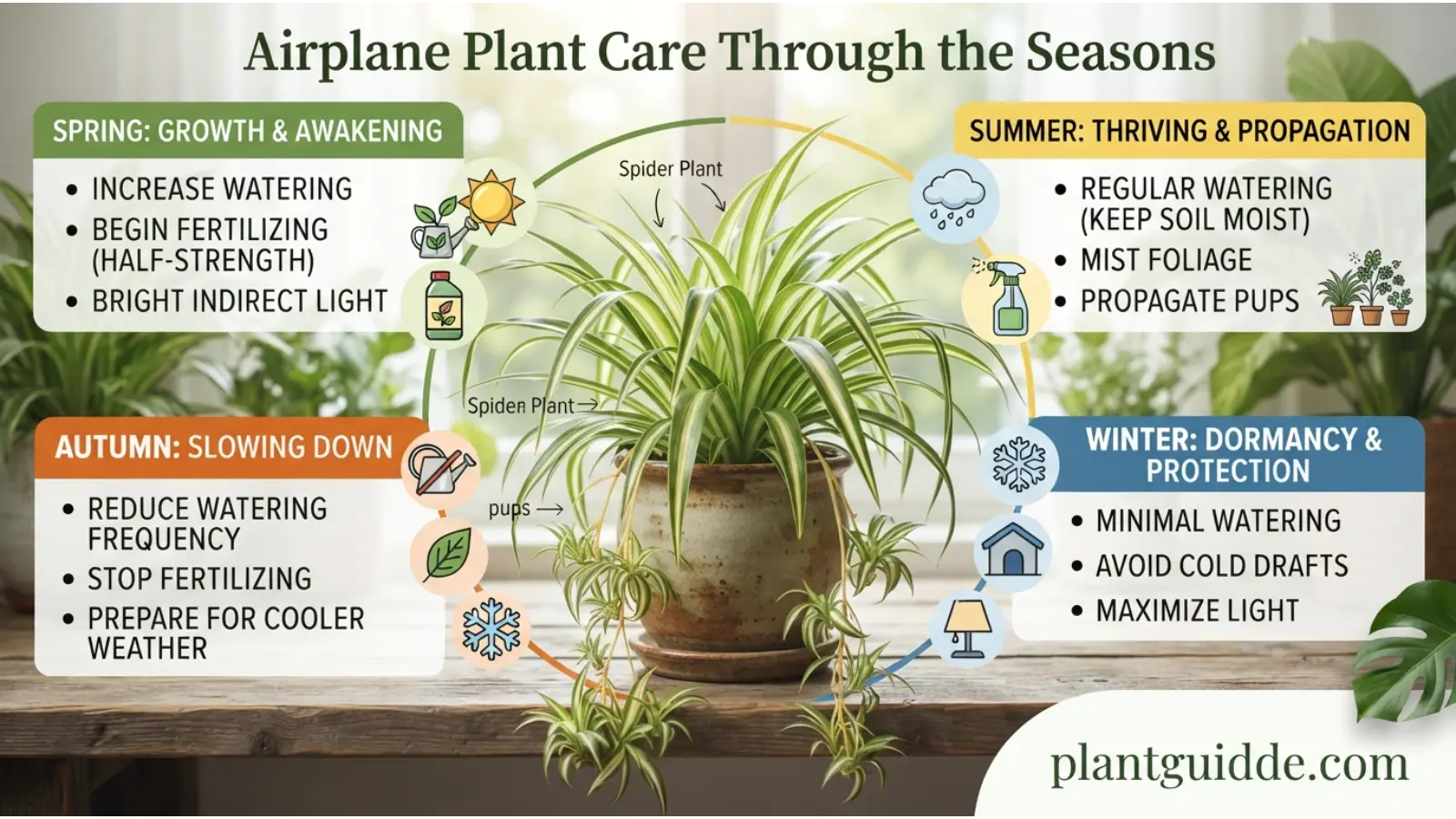
Airplane Plant Care Through the Seasons
Your watering and care routine should change as indoor conditions change.
Spring: Increasing light and active growth may increase water and nutrient needs.
Summer: Warm temperatures and brighter light can cause faster drying. Check soil more frequently.
Fall: As growth slows, allow the soil to dry appropriately between waterings and reduce feeding.
Winter: Lower light and cooler indoor conditions can dramatically reduce water use. Overwatering becomes an especially common problem.
The important principle is to respond to the plant and its environment rather than following a rigid watering calendar.
Image Suggestion: A realistic indoor airplane plant in a hanging pot near a bright window, showing healthy arching foliage, small plantlets, well-draining soil, and a simple care infographic for light and watering.
FAQs:
Is an airplane plant the same as a spider plant?
Yes. “Airplane plant” is a common name for the spider plant, Chlorophytum comosum. The plant is also sometimes called a ribbon plant because of its long, narrow foliage.
How much sunlight does an airplane plant need?
An airplane plant prefers bright, indirect light. It can tolerate lower light, but growth may slow and variegated foliage may become less pronounced. Protect it from intense direct afternoon sun.
How often should I water an airplane plant?
Water when the upper portion of the potting mix has dried rather than watering on a fixed schedule. Always consider temperature, light, humidity, pot size, and soil drainage.
Why does my airplane plant have brown tips?
Brown tips may result from dry conditions, inconsistent watering, fertilizer or mineral buildup, excessive sunlight, or root stress. Check the plant’s overall growing environment before assuming one specific cause.
Can I grow an airplane plant from its babies?
Yes. The small plantlets produced on long stems can be rooted in water or planted directly into moist potting mix. Once established, they can be separated from the mother plant and grown independently.
Final Thoughts
Successful airplane plant care is less about constant attention and more about getting the basic conditions right. Give the plant bright indirect light, well-draining soil, a container with drainage, and water only when the soil has begun to dry.
When brown tips, yellow leaves, or drooping appear, treat them as clues rather than immediately adding water or fertilizer. Check the soil, roots, light, and recent changes in the environment first.
With consistent conditions and occasional pruning or repotting, an airplane plant can remain a vigorous, attractive houseplant while producing the cascading plantlets that make it so distinctive.

Asad Mumtaz is a dedicated plant enthusiast and gardening writer with a passion for helping people care for their plants successfully. He specializes in plant care guides, indoor gardening, and practical growing tips for all skill levels. His content focuses on making gardening simple, enjoyable, and rewarding. Through his work, Asad shares reliable advice to help readers create thriving green spaces.