Baby tears plant care is one of those houseplants that looks delicate but can grow vigorously when its basic needs are met. Its tiny green leaves form a dense, soft-looking carpet over the soil, making it especially attractive in small pots, terrariums, hanging containers, and humid indoor spaces.
The challenge with baby tears plant care is finding the balance between moisture and drainage. Unlike drought-tolerant houseplants, baby tears does not appreciate being allowed to dry out completely. At the same time, constantly saturated soil can create conditions for root and stem problems.
Baby tears plant care your plant is becoming crispy, thinning out, yellowing, wilting, or developing dark patches, the answer is usually found by looking at its light, moisture, drainage, humidity, and airflow rather than simply watering more often.
Quick Answer
Baby tears plant care is mainly about maintaining consistent moisture, bright filtered light, good humidity, and well-draining soil. Baby tears (Soleirolia soleirolii) grows as a low, spreading mat of tiny rounded leaves and prefers soil that stays lightly moist without becoming waterlogged. Give it bright indirect light or partial shade, avoid harsh direct sun, and provide good airflow to reduce fungal problems.
What Is a Baby Tears Plant?
Baby tears, botanically known as Soleirolia soleirolii, is a low-growing, mat-forming perennial in the Urticaceae family. It produces slender creeping stems covered with very small rounded leaves and can form a dense green carpet as it spreads. The plant may also produce tiny pinkish-white flowers in summer.
It is also sold under names such as:
- Baby’s tears
- Mind-your-own-business
- Corsican creeper
- Helxine
- Angel’s tears
- Friendship plant
The name can cause confusion because several unrelated plants are sometimes marketed under similar common names. For reliable identification, look for the characteristic tiny rounded leaves growing along delicate creeping stems.
Baby tears naturally has a spreading habit rather than a tall, upright form. Under suitable conditions, it can reach only around 10 cm in height while spreading considerably wider.
That growth habit makes it useful as:
- A small indoor groundcover
- A terrarium plant
- A hanging-basket plant
- A container companion plant
- A humid-room houseplant
- A living carpet around larger plants
When grown outdoors, however, its vigorous creeping growth needs to be monitored. The RHS notes that Soleirolia soleirolii can spread rapidly and may become difficult to control in suitable conditions.
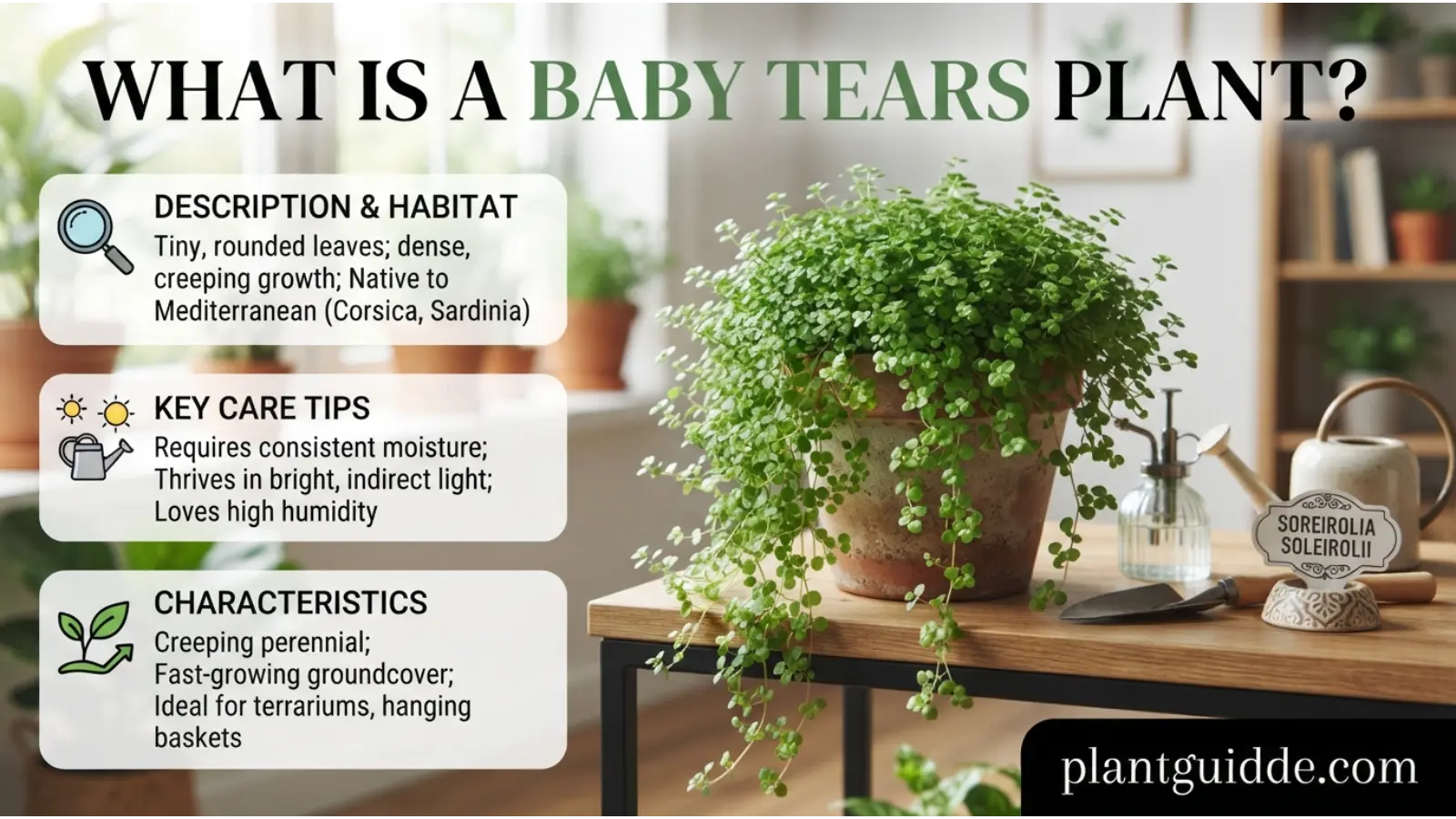
Baby Tears Plant Care at a Glance
| Care requirement | What baby tears prefers |
|---|---|
| Light | Bright filtered light or partial shade |
| Direct sun | Avoid strong hot afternoon sun |
| Water | Keep soil lightly and consistently moist |
| Soil | Moisture-retentive but well-draining |
| Humidity | Moderate to high humidity |
| Temperature | Mild, stable indoor conditions |
| Fertilizer | Light feeding during active growth |
| Pruning | Occasional trimming to control spread |
| Propagation | Division or stem sections |
| Growth habit | Low, creeping, mat-forming |
The RHS recommends growing baby tears under glass or indoors in a peat-free, loam-based compost with added grit, in full light protected from hot sun or in partial shade. It also recommends keeping the plant just moist in winter.
How Much Light Does Baby Tears Need?
Baby tears grows best in bright, filtered light or partial shade.
A position near an east- or north-facing window can work well, while a brighter south- or west-facing location may require protection from intense direct sunlight.
Light affects both the density and appearance of the plant. If the plant receives too little light, growth may become thin and stretched, with more visible gaps between stems. If it receives intense hot sunlight through glass, the tiny leaves can dry out or become scorched.
The RHS lists both full sun and partial shade for the species outdoors but specifically recommends shade from hot sun when grown under glass or as a houseplant.
Signs Your Baby Tears Needs More Light
Look for:
- Long, sparse stems
- Large gaps between leaves
- Slow spreading
- Pale or weak-looking foliage
- Growth leaning strongly toward a window
Move the plant gradually toward a brighter position rather than suddenly exposing it to strong midday sunlight.
Signs of Too Much Sun
Excessive light can cause:
- Crispy leaves
- Brown patches
- Faded foliage
- Rapid drying of the potting mix
- Wilting despite recently watering
If this happens, move it back from the window or provide a sheer curtain to soften the light.
How to Water Baby Tears
Watering is one of the most important parts of baby tears plant care.
The goal is consistently moist soil, not permanently wet soil.
Baby tears has fine foliage and relatively shallow, spreading growth, so allowing the entire root zone to become bone dry can cause rapid wilting. However, repeatedly keeping the roots saturated reduces air spaces in the soil and can encourage root or stem problems.
A better approach is to check the pot rather than follow a fixed watering calendar.
Before watering, feel the upper layer of the potting mix. If it is beginning to dry but the lower root zone is still slightly moist, the plant may not need another thorough watering yet.
When watering:
- Water evenly across the soil surface.
- Continue until excess water drains from the bottom.
- Allow the container to drain completely.
- Empty standing water from the saucer.
- Check the soil again before the next watering.
The RHS recommends checking whether houseplant compost has become dry rather than watering automatically on a schedule, and emphasizes that containers should have drainage holes.
How Often Should You Water Baby Tears?
There is no reliable number of days that works for every plant.
A baby tears plant in a warm, bright room may need water considerably more often than one in a cool, shaded room. Pot size, soil composition, humidity, airflow, season, and root density also change how quickly moisture disappears.
During active growth, check the soil frequently. In winter, reduce watering as growth slows, but do not allow the plant to become completely dry for long periods. The RHS recommends keeping it just moist during winter.
What Soil Is Best for Baby Tears?
Baby tears needs a potting mix that can hold some moisture while still draining excess water efficiently.
A useful indoor mix can contain:
- Quality peat-free potting mix
- Fine bark or another organic component
- Perlite or pumice
- A small amount of coarse material for drainage
The exact recipe is less important than the result. You want the mix to remain evenly moist without becoming heavy, compacted, or muddy.
The RHS recommends a peat-free, loam-based compost with added grit for indoor cultivation.
Why Drainage Matters
A common mistake is interpreting baby tears’ preference for moisture as a reason to use dense soil.
That can backfire.
If water remains trapped around the roots, the plant may begin to decline even though the leaves appear thirsty. A container without a drainage hole makes the problem worse because excess water has nowhere to escape.
If the soil stays wet for many days after watering, consider:
- Improving the potting mix
- Moving the plant to a brighter location
- Increasing airflow
- Checking whether the container is too large
- Confirming that the drainage hole is unobstructed
Does Baby Tears Need High Humidity?
Baby tears generally performs well in humid environments, and the RHS specifically identifies it as a foliage houseplant suitable for humid rooms.
Dry indoor air can cause the delicate foliage to lose moisture faster, particularly in warm rooms or around heating systems. Low humidity can contribute to wilting, crispy foliage, and poor-looking growth.
To improve humidity, you can:
- Group several plants together
- Keep the plant in a naturally humid room
- Use a humidifier when indoor air is very dry
- Place the pot near other moisture-loving plants
- Use a pebble tray carefully, keeping the pot above the water rather than sitting directly in it
Humidity should not be used as a substitute for proper watering or drainage. A humid room with stagnant air and constantly wet soil can create a different set of problems.
Good airflow matters too. The RHS recommends improving ventilation when fungal problems occur on houseplants.
Temperature and Location
Baby tears generally prefers mild, stable conditions rather than extreme heat or cold.
For an indoor plant, avoid placing it:
- Directly beside a heater
- In the path of hot or cold air from HVAC vents
- Against very hot glass
- In a location with sudden temperature fluctuations
A bright bathroom, kitchen, enclosed porch, or other naturally humid area can work well if the light is appropriate.
If you grow baby tears outdoors, remember that its behavior can be different from that of a container houseplant. It can form a dense groundcover and spread from small pieces of stem, so monitor it where spreading is undesirable.

How to Fertilize Baby Tears
Baby tears does not need heavy feeding.
During active growth, a diluted balanced houseplant fertilizer can be used occasionally according to the product’s label. Avoid repeatedly applying strong fertilizer because the plant’s delicate root system and small growing space do not require heavy nutrient doses.
Fertilizing is most useful when the plant has adequate light, appropriate moisture, and healthy roots. Fertilizer will not correct problems caused by poor drainage or insufficient light.
If your baby tears is growing steadily with healthy green foliage, there is usually no reason to increase feeding simply because growth is not extremely fast.
Pruning and Trimming Baby Tears
Pruning is generally not essential, but trimming can make the plant look fuller and help control its spread.
If stems become excessively long or begin growing outside the container:
- Use clean scissors.
- Trim the longest stems back to a healthy section.
- Remove damaged or dead growth.
- Keep the plant evenly shaped rather than cutting everything back at once.
Baby tears naturally produces creeping, rooting stems, so regular light trimming can be more useful than occasional severe pruning.
The RHS lists no pruning requirement for the species, meaning trimming is primarily a management and appearance choice rather than a basic survival requirement.
How to Repot Baby Tears
Baby tears usually does not need frequent repotting simply because it has filled the surface of its container. Its spreading habit can make a full-looking pot appear crowded even when the root system still has adequate room.
Consider repotting when:
- Roots are densely filling the container
- Water runs through unusually quickly
- The soil has become compacted
- Growth repeatedly wilts soon after watering
- The plant dries out much faster than it used to
Choose a container only slightly larger than the existing root system.
Avoid moving a small plant into a very large pot. Excess soil around a small root system can remain wet for too long, increasing the risk of root problems.
How to Propagate Baby Tears
Propagation is relatively straightforward because the plant naturally produces creeping stems.
The RHS lists division and seed as propagation methods.
For home growers, division is often the more practical approach.
Propagation by Division
- Water the parent plant lightly before dividing.
- Remove it carefully from the container.
- Separate a healthy section containing stems and roots.
- Place the division into fresh, moist potting mix.
- Keep it in bright filtered light.
- Maintain consistent moisture while it establishes.
You can also encourage sections of healthy creeping growth to root where they contact moist soil.
Avoid taking large amounts of material from a weak or severely stressed plant. Establishing healthy divisions is much easier when the parent plant is actively growing.
Why Is My Baby Tears Plant Turning Brown?
Brown or crispy foliage usually indicates that the plant is losing water faster than the roots can replace it, although the underlying cause can vary.
Possible causes include:
- Soil becoming too dry
- Low humidity
- Excessive direct sunlight
- Hot indoor temperatures
- Root damage
- Poor watering practices
Start by checking the soil rather than immediately adding more water.
If the soil is bone dry, rehydrate it thoroughly and then establish a more consistent watering routine. If the soil is already wet, watering more can make the problem worse.
Dry air is another possibility. The RHS notes that low humidity can produce shrivelled, crispy leaves and brown tips or edges on foliage houseplants.
Why Is My Baby Tears Turning Yellow?
Yellow leaves can have several causes, so the pattern matters.
If the soil stays wet for extended periods and multiple leaves begin yellowing, investigate the roots and drainage first.
If the plant is yellowing while the soil is extremely dry, underwatering or root damage may be contributing.
Other factors include:
- Poor light
- Nutrient problems
- Sudden environmental changes
- Natural aging of individual leaves
Do not automatically fertilize a yellow plant. First determine whether the plant is receiving appropriate light and whether its roots are experiencing the correct moisture conditions.
Why Is My Baby Tears Plant Wilting?
Wilting does not always mean the plant needs more water.
Check the soil.
If the soil is dry:
The plant may simply need thorough watering.
If the soil is wet:
Look for poor drainage, compacted soil, damaged roots, or inadequate airflow.
If the soil moisture is appropriate:
Check whether the plant has been exposed to excessive heat, intense sunlight, or very dry air.
This distinction is important because repeatedly watering a wilted plant with already-saturated soil can worsen root problems.
Why Is My Baby Tears Losing Leaves?
Leaf loss can occur after sudden environmental changes or prolonged stress.
Common possibilities include:
- Major changes in light
- Severe drying
- Overly wet soil
- Low humidity
- Temperature stress
- Root problems
If you recently moved the plant, avoid changing several conditions at once. Give it an appropriate location and allow it time to adjust while monitoring soil moisture and new growth.
New healthy growth is generally a more useful indicator of recovery than trying to make every damaged leaf look perfect again.
Common Baby Tears Plant Care Mistakes
Treating It Like a Drought-Tolerant Houseplant
Baby tears does not have the same watering strategy as plants such as snake plants or many succulents. Repeatedly allowing it to become completely dry can lead to rapid stress.
Keeping the Soil Permanently Wet
The opposite extreme is equally problematic. Moisture is necessary, but roots also need access to air.
Putting It in Harsh Direct Sun
Bright light is helpful, but intense sunlight through a window can dry or scorch the delicate foliage.
Using a Container Without Drainage
A decorative pot without a drainage hole can trap excess water around the roots.
Increasing Watering Without Checking the Soil
Wilting can result from both underwatering and root stress. Always inspect the growing medium first.
Ignoring Airflow
Humidity is helpful, but stagnant, continuously damp conditions can encourage fungal problems. Good ventilation helps maintain a healthier growing environment.
Baby Tears in a Terrarium
Baby tears is often associated with terrariums because its low-growing habit and preference for consistent moisture can work well in a suitably designed humid environment.
However, a closed terrarium is not automatically better.
A terrarium that remains excessively wet can develop:
- Condensation that never clears
- Mold
- Rot
- Weak, declining growth
- Poor air circulation
Use a well-draining growing medium and monitor condensation. If the environment remains excessively saturated, increase ventilation rather than adding more water.
For an open terrarium, the plant may require more frequent moisture checks because evaporation is greater.
Can Baby Tears Grow Outdoors?
Yes. Baby tears can be grown outdoors in suitable conditions and can function as groundcover or bedding.
The RHS lists it for outdoor growing and notes that it can be used in hanging baskets and other garden settings. It can also become deciduous in frost-prone areas.
The main consideration is its spreading behavior. Because the plant can spread from small pieces of stem, it should be monitored in gardens where you do not want it to move beyond its intended area.
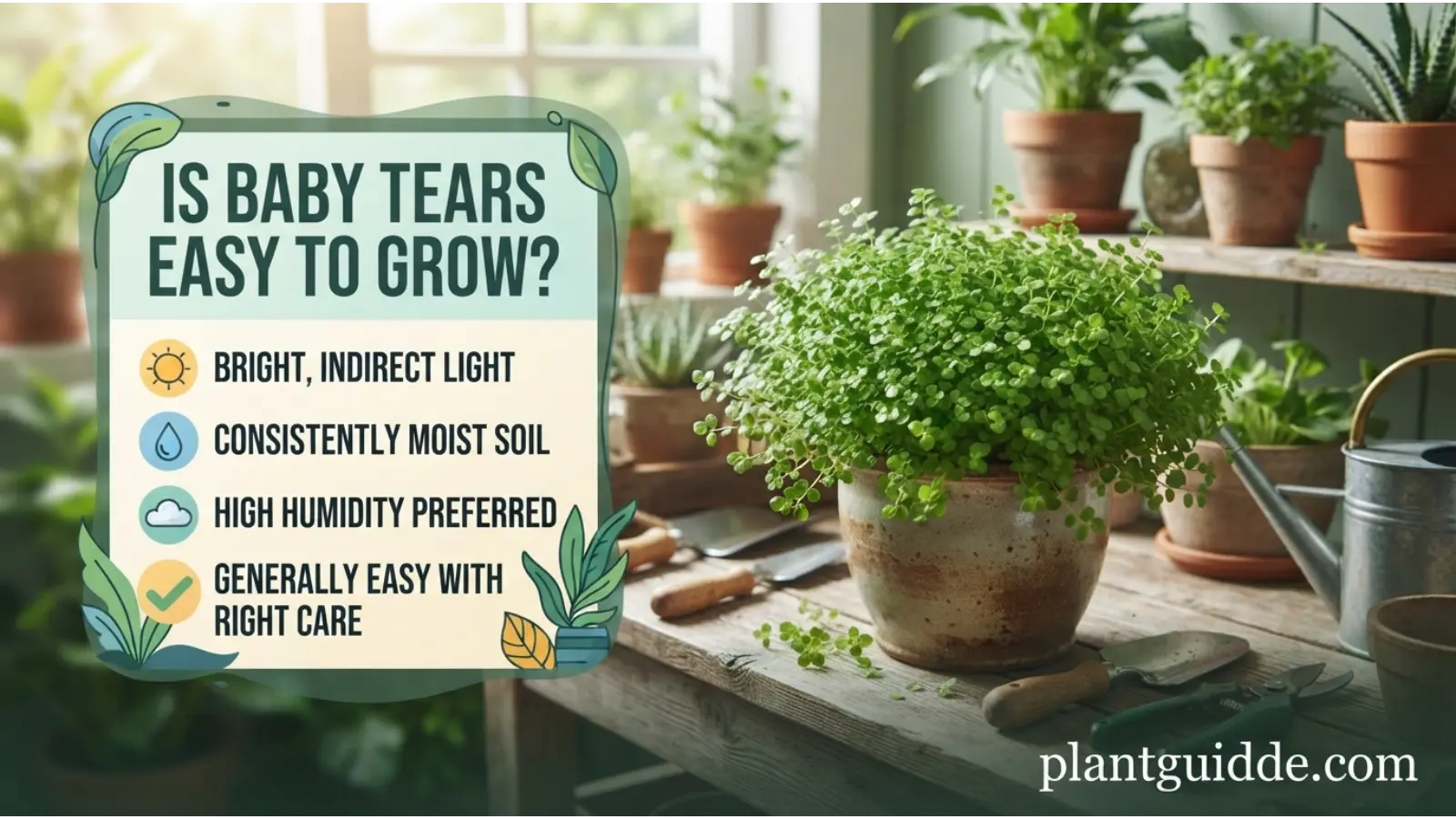
Is Baby Tears Easy to Grow?
Baby tears can be easy to maintain once you understand its particular moisture requirements.
It is not necessarily difficult because it requires complicated care. Instead, it is less forgiving of extremes than many beginner houseplants.
A healthy plant usually comes down to five fundamentals:
- Give it bright filtered light.
- Keep the growing medium consistently but moderately moist.
- Use a container with drainage.
- Provide adequate humidity without stagnant air.
- Adjust watering according to the environment rather than a fixed calendar.
Once those conditions are stable, the plant can produce dense, attractive growth with relatively little intervention.
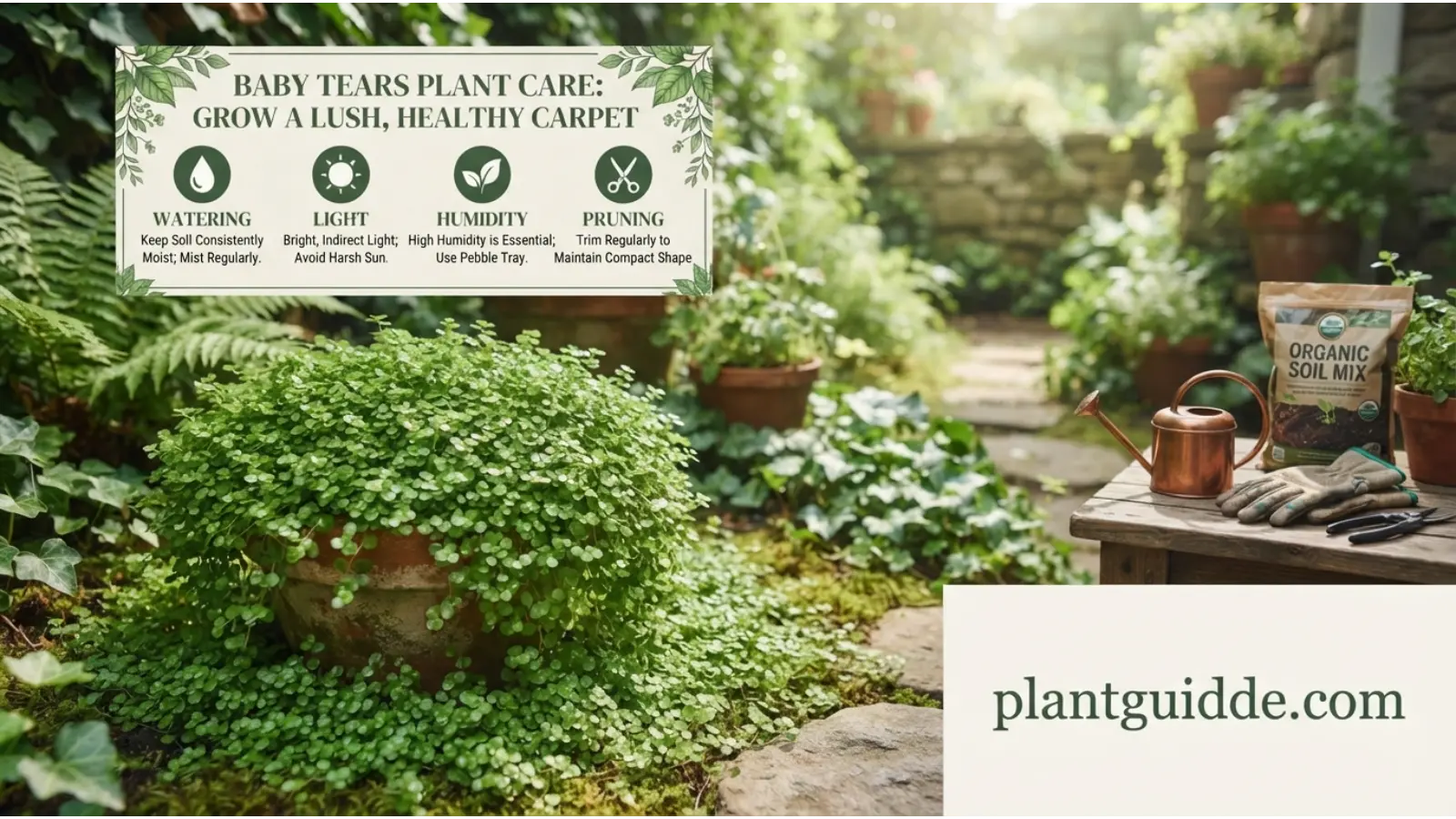
Image Suggestion: A realistic close-up of a lush baby tears plant spilling over a ceramic pot near a bright filtered window, showing its tiny rounded leaves, creeping stems, moist but well-drained soil, and a small watering can nearby. Add clean bottom-right space for “plantguidde.com.”
FAQs:
How often should I water a baby tears plant?
Water when the growing medium begins to dry rather than following a fixed schedule. Baby tears prefers consistently moist soil, but the container should drain freely and should not remain saturated. Warm, bright conditions may require more frequent checks than cool or shaded conditions.
Does baby tears need direct sunlight?
Baby tears can tolerate bright light and some sun, but harsh direct sunlight can dry or scorch its delicate foliage. For indoor growing, bright filtered light or partial shade is generally easier to manage. The RHS specifically recommends protecting indoor plants from hot sun.
Why is my baby tears plant turning brown and crispy?
Brown, crispy foliage can result from underwatering, dry air, excessive sunlight, heat, or root problems. Check the soil first. If it is dry, water thoroughly; if it is already wet, investigate drainage and root health instead of adding more water.
Can baby tears grow in low light?
It may survive in lower light, but consistently insufficient light can produce sparse, weak growth. A brighter filtered location is generally better for maintaining dense, attractive foliage. Illinois Extension lists baby tears among houseplants requiring high or bright light.
Is baby tears safe to grow in a terrarium?
Yes, its low-growing form and preference for consistent moisture can make it suitable for terrarium culture. The main concern is excessive moisture and poor ventilation. A terrarium should provide moisture without creating continuously saturated, stagnant conditions.
Final Thoughts
Successful baby tears plant care is less about following a strict watering schedule and more about maintaining a stable growing environment. Give Soleirolia soleirolii bright filtered light, evenly moist but well-drained soil, reasonable humidity, and good airflow.
When the plant starts declining, resist the temptation to immediately water or fertilize it. Check the soil, inspect the light, consider humidity and airflow, and look for signs of root stress. Those simple checks usually reveal what needs to change.
For most indoor growers, the best next step is to find a bright location away from harsh afternoon sun, place the plant in a container with drainage, and begin checking soil moisture regularly rather than watering by the calendar.

Asad Mumtaz is a dedicated plant enthusiast and gardening writer with a passion for helping people care for their plants successfully. He specializes in plant care guides, indoor gardening, and practical growing tips for all skill levels. His content focuses on making gardening simple, enjoyable, and rewarding. Through his work, Asad shares reliable advice to help readers create thriving green spaces.