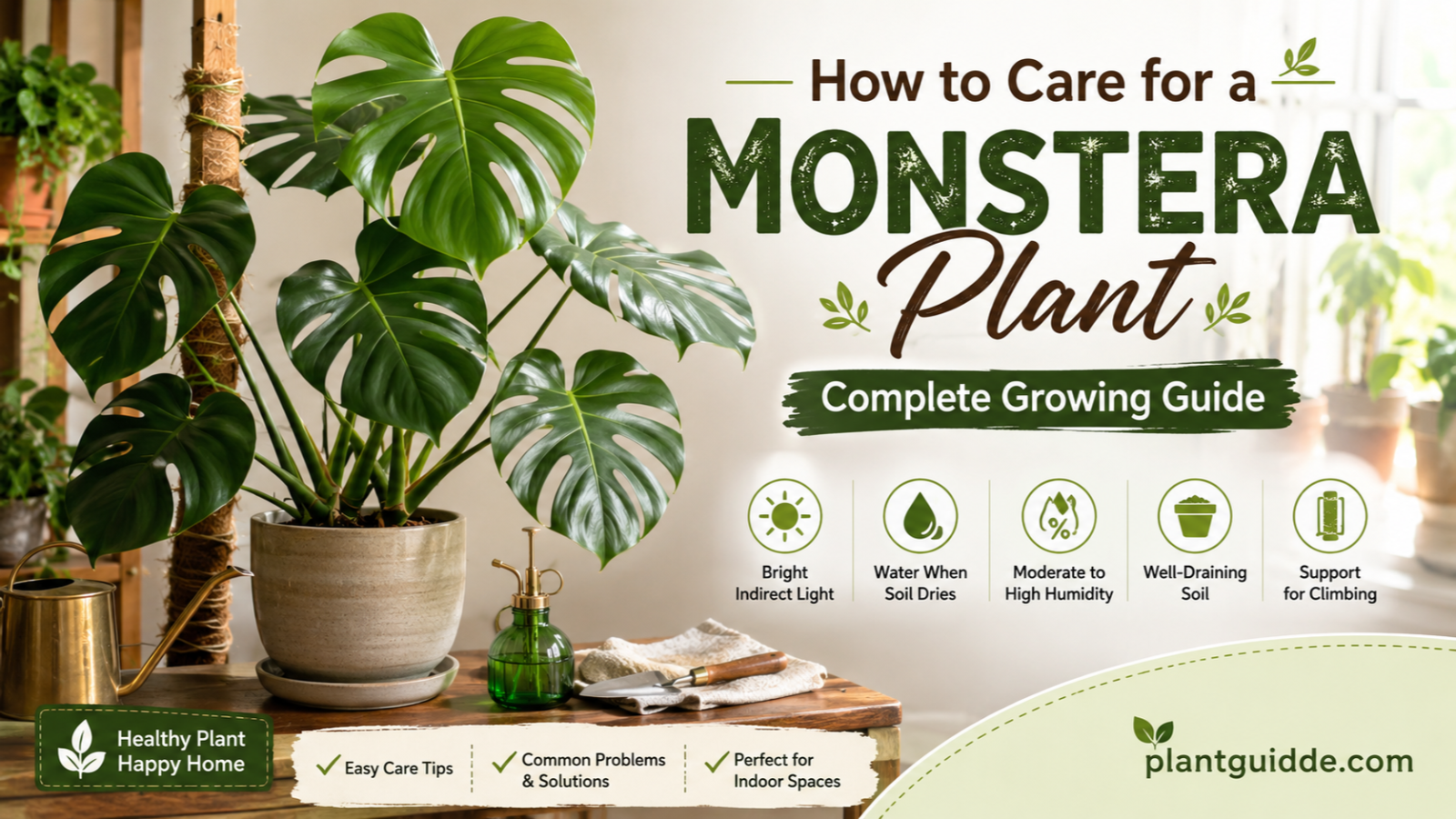
Few houseplants can transform a room as quickly as a healthy Monstera. Care for a Monstera Plant large, glossy leaves and natural splits instantly create a lush, tropical feel. But when something goes wrong, yellow leaves, brown edges, curling foliage, slow growth, or missing splits can quickly reveal the problem.
Learning how to care for a monstera plant is less about following a strict schedule and more about understanding what your plant needs. Monsteras thrive with bright filtered light, well-draining soil, consistent moisture, warmth, humidity, and proper support as they grow.
Once you understand how light, watering, soil, humidity, temperature, and support work together, Monstera care becomes much easier—and your plant can reward you with stronger growth and healthier, more dramatic foliage.
Quick Answer
To learn how to care for a monstera plant, give it bright, indirect light, a well-draining potting mix, and water when the top 1–2 inches of soil becomes dry. Keep it warm and moderately humid, provide a sturdy support such as a moss pole or trellis, and use a pot with drainage holes. Rotate the plant regularly and prune damaged leaves to encourage balanced, healthy growth.
Understanding Your Monstera Plant
The name Monstera refers to a genus of tropical plants in the arum family, Araceae. Several species and cultivars are grown as houseplants, but Monstera deliciosa is one of the most recognizable.
Its natural growth habit explains many of its indoor-care requirements.
Monsteras are climbing plants. In their native tropical environments, they use trees and other structures for support rather than growing as compact, upright plants. As they mature, their leaves can become considerably larger, and established plants may produce increasingly pronounced fenestrations—the characteristic holes and splits in the foliage.
This is why a mature Monstera often looks very different from a small plant purchased from a nursery.
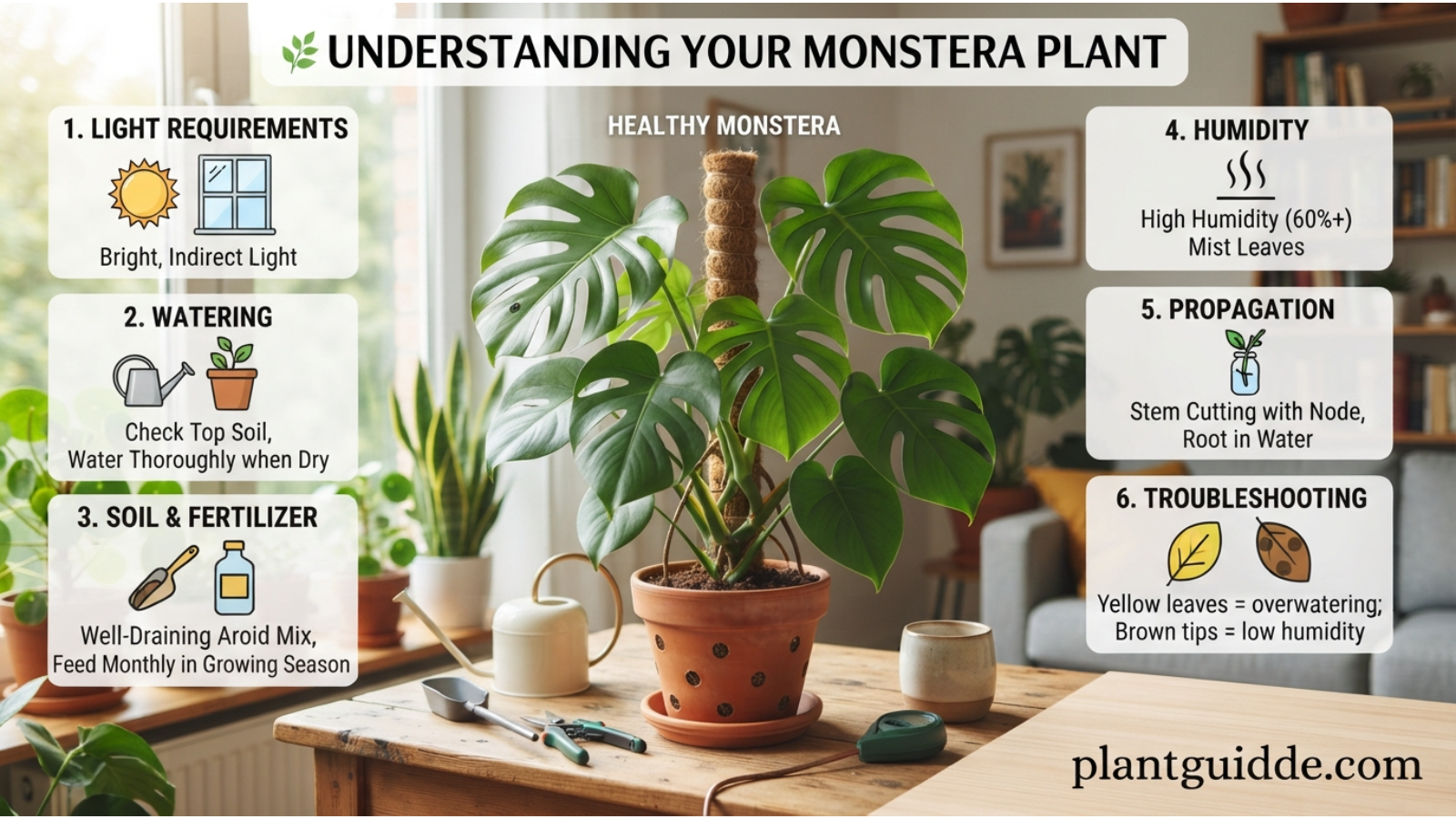
How to Care for a Monstera Plant
Successful Monstera care comes down to maintaining a stable growing environment rather than constantly correcting problems.
The ideal conditions at a glance
| Care factor | What a Monstera generally prefers |
|---|---|
| Light | Bright, indirect light |
| Water | Water thoroughly when the upper soil layer dries |
| Soil | Airy, well-draining mix |
| Humidity | Moderate to high humidity is beneficial |
| Temperature | Warm, stable indoor conditions |
| Pot | Container with drainage holes |
| Fertilizer | Balanced feeding during active growth |
| Support | Moss pole, trellis, or sturdy stake |
| Pruning | Remove damaged or unhealthy growth as needed |
| Repotting | When roots become crowded or soil structure deteriorates |
The exact frequency will vary with your home. A Monstera in a bright, warm room may use water much faster than one sitting several feet from a window.
Give Your Monstera the Right Light
Light is one of the most important factors in Monstera growth.
A Monstera generally performs best in bright, indirect light. An area near a bright window can work well, provided intense direct sun is filtered or gradually introduced.
Too little light can result in:
- Slow growth
- Smaller leaves
- Longer gaps between leaves
- Weak or stretched stems
- Reduced fenestration on new leaves
On the other hand, intense direct sunlight through glass can scorch foliage, particularly when a plant has been accustomed to lower light.
How to judge the location
Instead of relying only on a fixed distance from the window, observe the plant.
A good location usually provides plenty of ambient daylight without harsh midday rays continuously hitting the leaves.
Care for a Monstera Plant the Monstera is growing toward the window or producing unusually long spaces between leaves, it may be asking for more light.
Practical tip: Rotate the pot every week or two so one side does not consistently face the light. This encourages more balanced growth.
Image Suggestion: Diagram showing low light, bright indirect light, and harsh direct sunlight zones around a window.
Water Your Monstera Correctly
Watering is where many Monstera problems begin.
The goal isn’t to keep the soil permanently wet. Instead, allow the upper portion of the potting mix to dry somewhat before watering again.
For many indoor Monsteras, checking the top 1–2 inches of soil is a useful starting point. Stick your finger into the mix or use another reliable method to check moisture.
When the upper layer has dried and the plant needs water:
- Water slowly and thoroughly.
- Allow excess water to drain from the bottom.
- Empty standing water from the saucer or cachepot.
- Do not water again simply because a calendar says it is time.
Why watering frequency varies
There is no universal “water your Monstera every seven days” rule.
Water use depends on:
- Light intensity
- Temperature
- Humidity
- Pot size
- Root development
- Soil composition
- Season
- Air movement
A plant in bright light and a warm room may dry substantially faster than the same plant in a dim, cool corner.
Signs of watering problems
Possible overwatering:
- Soil stays wet for a long time
- Yellowing leaves
- Soft or declining growth
- Unpleasant-smelling soil
- Root deterioration
Possible underwatering:
- Drooping
- Dry, crispy edges
- Very dry potting mix
- Leaves becoming less firm
Remember that drooping alone doesn’t prove underwatering. Root problems can also prevent a plant from taking up water properly.
Use an Airy, Well-Draining Soil Mix
Monstera roots need both moisture and oxygen.
A dense potting mix that remains saturated for too long can reduce air around the roots and create conditions that encourage root problems.
A useful indoor Monstera mix is one that retains some moisture while draining excess water efficiently.
You can build an airy mix using components such as:
- Quality indoor potting mix
- Orchid bark
- Perlite or pumice
- Coco coir or another moisture-retaining component, depending on the mix
The exact recipe isn’t as important as the final structure.
A good test: after watering, the mix should drain readily rather than behaving like heavy, compact mud.
Don’t confuse drainage with dryness
A well-draining mix doesn’t mean water should race through the pot without wetting the root zone.
You want a balance:
Water retention + air space + drainage = healthier roots
Image Suggestion: Cross-section illustration comparing compact, waterlogged soil with an airy Monstera potting mix.
Choose the Right Pot
A Monstera does not automatically need a huge pot because it can eventually become large.
An oversized container holds more unused soil around the roots, which can take longer to dry. This increases the risk of prolonged moisture.
Choose a pot that is appropriately sized for the current root system and has drainage holes.
When repotting, moving up only moderately in pot size is usually more practical than jumping into a dramatically larger container.
When should you repot?
Look for signs such as:
- Roots circling heavily around the root ball
- Roots emerging from drainage holes
- Water moving through the pot unusually quickly
- Growth slowing despite appropriate care
- Potting mix breaking down or becoming compacted
Repotting is also an opportunity to inspect the roots.
Healthy roots are generally firm. Mushy, dark, deteriorating roots deserve attention.
Keep Humidity Reasonable
Monsteras come from tropical environments, so they generally appreciate moderate to higher humidity indoors.
However, you don’t necessarily need to turn your home into a greenhouse.
Care for a Monstera Plant the air is very dry, you may notice:
- Brown leaf edges
- Crispy tips
- Increased moisture loss
- New leaves struggling to unfurl cleanly
A humidifier is often more predictable than repeatedly misting the leaves.
Does misting increase humidity?
Misting can temporarily put moisture on leaf surfaces, but it is not a reliable way to maintain consistently higher room humidity.
If your indoor air is genuinely dry, improving the surrounding environment is more effective.
Practical tip: Avoid placing the Monstera directly against a heating vent, radiator, or strong air-conditioning outlet. Rapidly moving hot or cold air can stress foliage even when the average room temperature seems comfortable.
Maintain a Warm, Stable Temperature
Monsteras prefer warm indoor conditions and generally dislike sudden temperature changes.
Keep the plant away from:
- Cold drafts
- Frequently opened exterior doors
- Heating vents
- Strong air-conditioning outlets
- Very cold windows during winter
You don’t need to maintain tropical temperatures around the clock. Stability matters more than trying to create an extreme environment.
If a plant suddenly develops problems after being moved from a warm nursery into a much colder location, environmental shock may be part of the explanation.
Give Your Monstera Something to Climb
This is one of the most overlooked parts of how to care for a monstera plant.
Monsteras naturally climb. A mature plant may therefore become much more attractive and structurally organized when given appropriate support.
Useful options include:
- Moss poles
- Coir poles
- Trellises
- Sturdy stakes
As the plant grows, guide the stems toward the support rather than aggressively bending them.
Why support matters
A climbing structure can help the plant grow upward rather than sprawling across furniture. It can also better accommodate the plant’s natural growth habit.
A supported Monstera may eventually produce larger, more mature-looking foliage, although support alone doesn’t guarantee dramatic fenestrations.
Image Suggestion: Step-by-step illustration showing how to attach a Monstera stem to a moss pole without damaging it.
Fertilize During Active Growth
Monsteras need nutrients to produce new foliage, particularly when they are actively growing.
A balanced houseplant fertilizer can be used according to the product’s instructions during the growing season.
Avoid the common mistake of assuming that more fertilizer equals faster growth.
Excess fertilizer can contribute to salt buildup and root stress.
A better approach
- Fertilize a healthy, actively growing plant.
- Follow the fertilizer’s recommended dilution and frequency.
- Avoid heavy feeding when the plant is stressed.
- Reduce or pause feeding when growth naturally slows.
If the plant is struggling because of poor light, root problems, or incorrect watering, fertilizer is not a substitute for fixing the underlying issue.
Understand Monstera Fenestrations
Those holes and splits are one of the reasons Monsteras are so popular.
But a young Monstera may produce mostly solid leaves. That’s normal.
Fenestration is influenced by:
- Plant maturity
- Genetics
- Light
- Overall growing conditions
- Growth habit
Why isn’t my Monstera developing splits?
The first thing to examine is light.
If a Monstera is healthy but remains in a low-light location, it may not have the resources to develop the same mature foliage as a vigorous plant receiving suitable light.
Also consider the plant’s age. A small juvenile Monstera should not be expected to immediately produce giant, heavily split leaves.
Don’t force fenestration. Cutting holes into young leaves does not create genuine natural fenestrations.
Prune Your Monstera Without Overdoing It
Pruning can improve appearance and remove damaged or unhealthy foliage.
You can remove:
- Completely yellow or dead leaves
- Severely damaged foliage
- Diseased tissue when appropriate
- Unwanted growth that interferes with the plant’s shape
Use clean, sharp pruning tools.
Avoid removing healthy leaves simply because they are older or imperfect. Every healthy leaf contributes to photosynthesis and helps the plant support new growth.
What about aerial roots?
Monsteras naturally produce aerial roots.
These roots are not automatically a sign that something is wrong.
You can:
- Guide them toward a support
- Allow them to grow naturally
- Redirect them into the potting mix if appropriate
You generally don’t need to cut healthy aerial roots just because they look unusual.
Common Monstera Problems and What They Mean
A Monstera’s symptoms can provide useful clues, but one symptom does not always have one cause.
Yellow Leaves
A yellow leaf can occur naturally as an older leaf ages, but widespread or repeated yellowing deserves investigation.
Check:
- How wet the soil stays.
- Whether the pot drains properly.
- How much light the plant receives.
- Whether the roots appear healthy.
- Whether watering has recently changed.
If several leaves turn yellow while the soil remains wet for long periods, excessive moisture should be high on your troubleshooting list.
Brown Leaf Tips
Brown tips can be associated with dry conditions, inconsistent watering, salt buildup, or other environmental stresses.
Don’t immediately assume that humidity is the only problem.
Consider the whole environment:
Light → watering → soil → humidity → fertilizer → roots
Correcting the underlying condition is more useful than simply trimming the brown section.
Curling Leaves
Curling can occur when the plant is losing water faster than the roots can replace it.
Check the soil first.
If the soil is extremely dry, watering may solve the immediate problem. If the soil is wet and the leaves continue curling, investigate root health, environmental stress, or other causes instead of adding more water.
Drooping Monstera
Drooping is another symptom that requires context.
Possible causes include:
- Underwatering
- Root damage
- Sudden environmental changes
- Excessive heat
- Poor root aeration
A drooping plant with bone-dry soil is a different situation from a drooping plant sitting in saturated soil.
Leaves Turning Black
Black or very dark, deteriorating areas can indicate significant stress.
Potential causes include:
- Root problems
- Cold injury
- Tissue damage
- Persistent excessive moisture
- Disease-related problems
If the discoloration is spreading rapidly, inspect the plant closely rather than treating it as a simple watering issue.
A Simple Monstera Troubleshooting Guide
| Symptom | First thing to check | What to avoid |
|---|---|---|
| Yellow leaves | Soil moisture and drainage | Watering automatically |
| Brown tips | Dryness, humidity, salts | Assuming one cause |
| Curling leaves | Soil moisture and environment | Adding water blindly |
| Slow growth | Light and root condition | Excess fertilizer |
| Small leaves | Light, maturity, support | Expecting instant maturity |
| No fenestrations | Plant age and light | Cutting holes manually |
| Persistent wet soil | Drainage and soil structure | Keeping a watering schedule |
| Drooping | Soil + roots + temperature | Diagnosing from appearance alone |
How to Care for a Monstera Plant in Different Seasons
Spring and Summer
During active growth, your Monstera may:
- Produce leaves more frequently
- Use water faster
- Benefit from regular feeding
- Need more space as growth accelerates
Check soil moisture more frequently rather than automatically increasing watering.
Fall and Winter
Growth often slows when light levels decrease.
This means the plant may use water more slowly.
A common winter mistake is continuing the same watering frequency used during bright summer conditions.
Instead, let the plant’s soil and environment determine when it needs water.
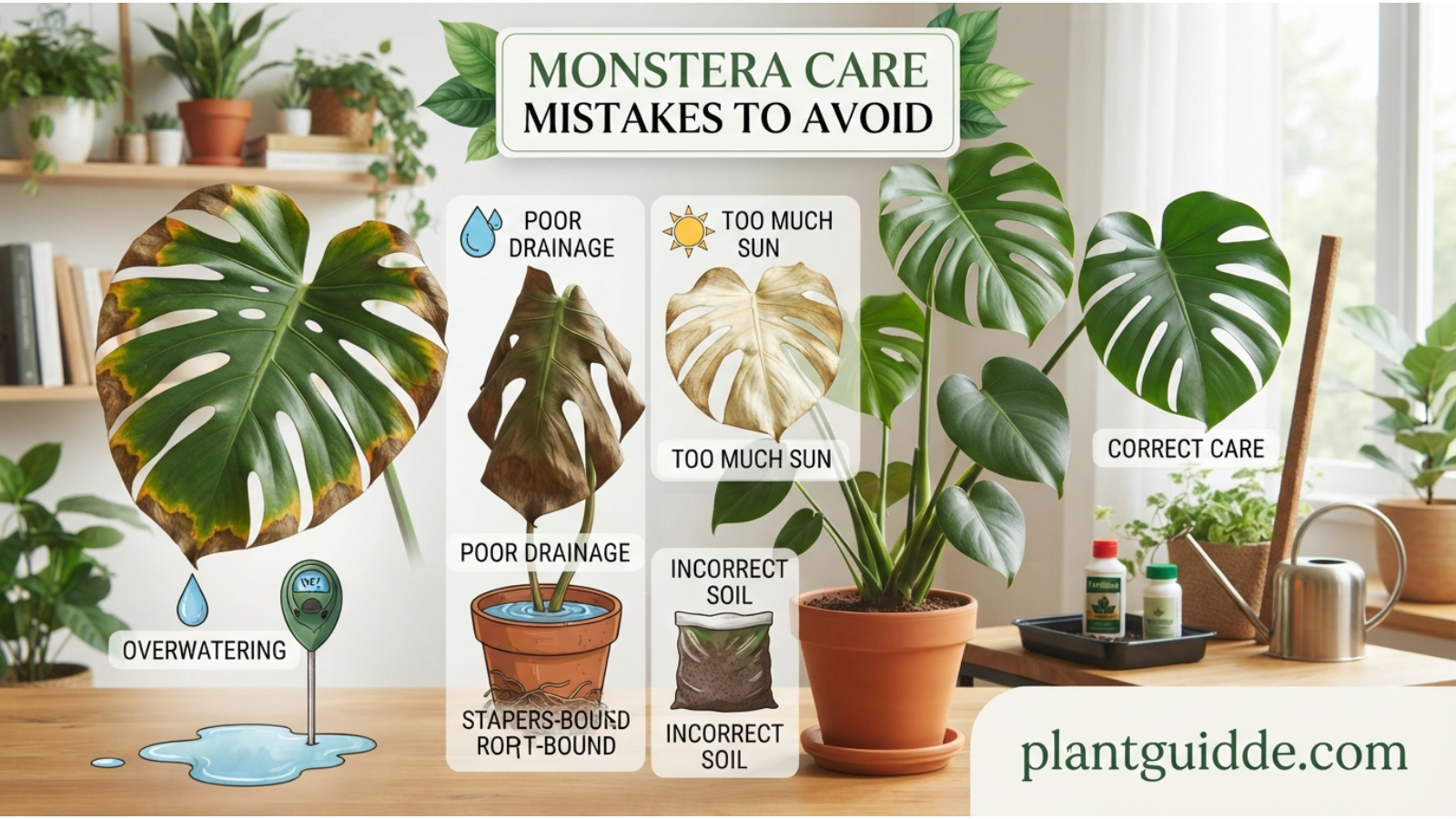
Monstera Care Mistakes to Avoid
1. Watering on a fixed schedule
Calendar-based watering ignores changes in light, temperature, and soil moisture.
2. Keeping the soil constantly wet
Monsteras need moisture, but their roots also need oxygen.
3. Putting the plant in deep shade
A Monstera may survive low light for a while without thriving.
4. Using a huge decorative pot
Large amounts of unused wet soil can dry slowly.
5. Overfertilizing
Extra fertilizer cannot compensate for inadequate light or damaged roots.
6. Chasing humidity while ignoring watering
Humidity matters, but it does not override poor drainage or root problems.
7. Cutting every aerial root
Aerial roots are a normal part of Monstera growth.
8. Expecting juvenile plants to look mature
Young plants naturally have different leaf shapes from established specimens.
How to Build a Better Monstera Care Routine
Instead of trying to remember dozens of rules, use a simple observation-based routine.
Once a week
Check:
- Soil moisture
- Leaf condition
- New growth
- Pest activity
- Overall posture
Every few weeks
Look at:
- Whether the plant is leaning
- Whether stems need support
- Whether roots are becoming crowded
- Whether leaves are accumulating dust
Seasonally
Reassess:
- Light exposure
- Watering frequency
- Fertilizer needs
- Temperature
- Humidity
This approach works better than following a rigid schedule because your plant’s needs change with its environment.
FAQs,
How often should I water a Monstera?
Water when the upper portion of the soil has dried rather than watering according to a fixed weekly schedule. Environmental conditions determine how quickly the soil dries.
How much light does a Monstera need?
Bright, indirect light is generally ideal. Strong direct sunlight can scorch leaves, while very low light can slow growth and contribute to smaller foliage.
Why are my Monstera leaves turning yellow?
Check soil moisture and drainage first, especially if several leaves are yellowing. Persistent wet soil can indicate a root-zone problem.
Why does my Monstera have brown tips?
Brown tips may result from dry conditions, inconsistent watering, salt accumulation, or other environmental stress. Examine the entire growing environment before changing one factor.
Why aren’t my Monstera leaves splitting?
The plant may be too young, receiving insufficient light, or simply not mature enough to produce highly fenestrated leaves. Genetics also influence leaf development.
Should I mist my Monstera?
Misting is not necessary for routine Monstera care and does not reliably maintain higher room humidity. A humidifier can provide more consistent environmental humidity when needed.
Does a Monstera need a moss pole?
Not necessarily, but support is useful because Monsteras naturally climb. A sturdy pole or trellis can help organize growth and support larger plants.
Should I cut off yellow Monstera leaves?
If a leaf is completely yellow and declining, removing it is reasonable. If only a small portion is yellow, first determine why the discoloration is occurring.
Can a Monstera grow in low light?
It can tolerate lower-light conditions, but growth is generally better when the plant receives bright, indirect light.
When should I repot my Monstera?
Repot when roots have substantially filled the container, drainage has deteriorated, or the potting mix has broken down. Move to a moderately larger container rather than an excessively large one.
Final Takeaway
The key to how to care for a monstera plant is not complicated equipment or a perfect watering calendar. It is learning to read the plant and respond to its growing conditions.
Give your Monstera bright indirect light, well-draining soil, appropriate watering, good drainage, warmth, reasonable humidity, and climbing support. Then pay attention to changes in the leaves and soil before problems become severe.
Most importantly, don’t treat every yellow, brown, or drooping leaf as a separate mystery. Look at the entire growing environment. Once you understand how light, water, roots, and humidity interact, caring for a Monstera becomes much more predictable, and your plant has a much better chance of producing the large, healthy, naturally fenestrated foliage that makes it such a popular houseplant.

Asad Mumtaz is a dedicated plant enthusiast and gardening writer with a passion for helping people care for their plants successfully. He specializes in plant care guides, indoor gardening, and practical growing tips for all skill levels. His content focuses on making gardening simple, enjoyable, and rewarding. Through his work, Asad shares reliable advice to help readers create thriving green spaces.