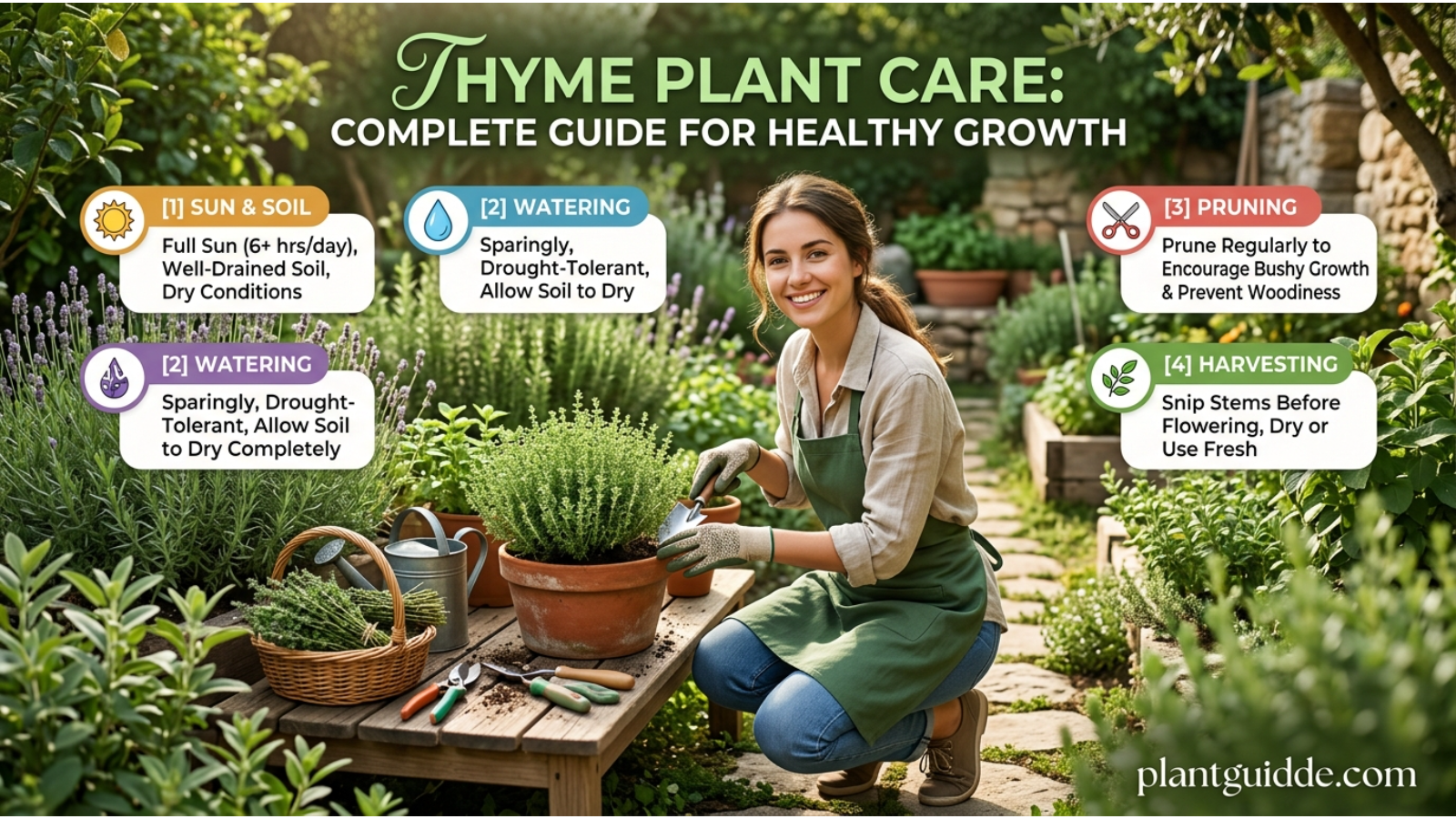
Thyme plant care is one of those herbs that can be surprisingly easy to grow once you understand what it does not like. Unlike thirsty herbs that need consistently moist soil, thyme naturally prefers drier conditions, strong light, and excellent drainage.
The biggest problems usually come from treating thyme like a typical leafy houseplant. Frequent watering, heavy soil, poor drainage, and insufficient sunlight can lead to weak growth, yellow leaves, root problems, and a sparse-looking plant.
Good thyme plant care is therefore less about constant attention and more about getting the growing conditions right from the beginning. Thyme plant care you are growing thyme in a garden bed, container, herb garden, or sunny windowsill, the same basic principles apply.
Quick Answer
Thyme plant care is easiest when you provide plenty of sunlight, fast-draining soil, good airflow, and relatively infrequent watering. Thyme prefers to dry somewhat between waterings and performs poorly when its roots stay wet. Regular harvesting keeps the plant compact, while avoiding excessive fertilizer helps preserve its strong flavor and aromatic growt
What Is Thyme?
Thyme is a group of aromatic perennial herbs in the Thymus genus and mint family, Lamiaceae. Common thyme, Thymus vulgaris, is one of the most widely grown culinary types.
Its small leaves contain aromatic oils that give thyme its distinctive earthy, slightly peppery flavor. Depending on the variety, plants may grow upright or form low, spreading mats.
Thyme is valued both as a culinary herb and as an ornamental plant. Its small flowers can also attract pollinating insects when the plant is allowed to bloom.
For home gardeners, thyme has another major advantage: it generally prefers lean, dry, well-drained conditions rather than rich, constantly moist soil.
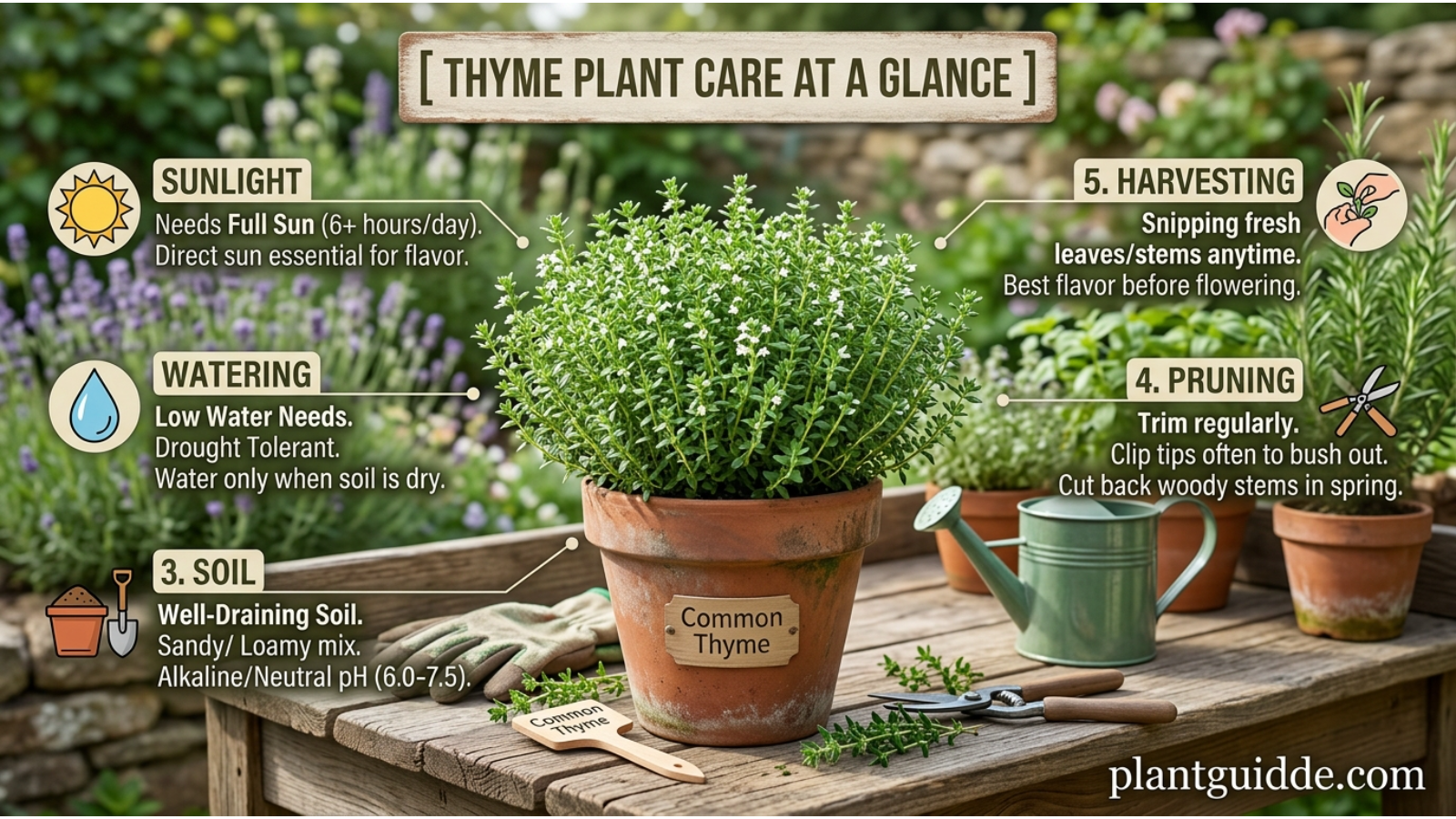
Thyme Plant Care at a Glance
| Requirement | Best condition |
|---|---|
| Light | Full sun, around 6–8 hours daily |
| Soil | Light, gritty, and very well-draining |
| Water | Water thoroughly, then allow soil to dry somewhat |
| Humidity | Average household humidity is usually sufficient |
| Temperature | Warm conditions with good airflow |
| Fertilizer | Light feeding only when needed |
| Pruning | Regular harvesting and light trimming |
| Pot | Container with drainage holes |
| pH | Slightly acidic to neutral soil |
| Growth habit | Upright or spreading, depending on variety |
The most important combination is sun + drainage + controlled watering. If those three are right, thyme usually requires relatively little maintenance.
How Much Light Does Thyme Need?
Thyme grows best in full sun.
Aim for approximately 6 to 8 hours of direct sunlight per day when possible. A bright south-facing or west-facing window can work well indoors, although indoor plants may need supplemental grow lighting if natural light is weak.
Signs Thyme Is Not Getting Enough Light
A thyme plant receiving insufficient light may develop:
- Long, weak stems
- Large gaps between leaves
- Pale or less aromatic foliage
- Slow growth
- A floppy or stretched appearance
- Reduced branching
This is especially common when thyme is grown indoors several feet away from a window.
Practical tip: Don’t judge light by how bright a room feels to your eyes. A room can look bright while providing much less usable light than thyme needs.
If an indoor thyme plant becomes thin and stretched, move it closer to a bright window or supplement natural light with a suitable grow light.
How to Water Thyme
Watering is one of the most important parts of thyme plant care—and one of the easiest places to make a mistake.
Thyme prefers soil that dries between waterings rather than remaining continuously damp.
Instead of watering according to a fixed calendar, check the soil first.
A Better Watering Method
- Check the top several centimeters of soil with your finger.
- If the soil still feels noticeably moist, wait.
- When the soil has dried considerably, water thoroughly.
- Allow excess water to drain completely.
- Empty water collected in a saucer or decorative outer pot.
The exact frequency depends on temperature, sunlight, pot size, soil composition, and whether the plant is indoors or outdoors.
A thyme plant in a hot outdoor container may need water considerably more often than one growing in a cool indoor environment.
Why Overwatering Causes Problems
Thyme’s roots need access to oxygen as well as water. When soil remains saturated for extended periods, air spaces become filled with water, reducing oxygen around the roots.
This can contribute to:
- Yellowing leaves
- Soft or weak stems
- Leaf drop
- Root deterioration
- Slow growth
- A sour or unpleasant soil smell
If thyme repeatedly struggles despite being watered regularly, more water is often not the solution.
Best Soil for Thyme
The ideal soil for thyme is loose, gritty, and fast-draining.
Heavy garden soil or moisture-retentive potting mixes can create problems, particularly in containers.
A good container mix should allow water to pass through quickly rather than forming a wet, compact mass.
You can improve drainage by combining quality potting mix with materials such as:
- Coarse sand
- Perlite
- Pumice
- Fine horticultural grit
The exact recipe is less important than the result: water should drain freely, and the roots should not sit in saturated soil.
Should You Use Rich Soil?
Not necessarily.
Thyme doesn’t need the highly fertile, moisture-retaining soil that some vegetable crops prefer. Excessively rich conditions combined with frequent watering can encourage soft, overly lush growth that is less suited to thyme’s naturally dry-growing habit.
A moderately fertile, well-drained medium is generally a better choice.
Choosing the Right Pot for Thyme
If you are growing thyme in a container, drainage should be a priority.
Choose a pot with at least one proper drainage hole. The container should also be appropriately sized for the root system rather than dramatically oversized.
An excessively large pot holds more unused soil, which can remain wet longer after watering.
Terracotta vs. Plastic Pots
Both can work, but they behave differently.
Terracotta is porous and allows moisture to evaporate through the container walls, which can be helpful for a plant that dislikes persistently wet soil.
Plastic pots retain moisture longer. This isn’t automatically a problem, but watering needs to be adjusted accordingly.
For beginners who tend to overwater, a well-draining terracotta pot can be particularly useful.
How to Grow Thyme Outdoors
Thyme is well suited to sunny herb gardens, raised beds, rock gardens, borders, and containers.
Choose a location with:
- Strong sunlight
- Good drainage
- Adequate airflow
- No persistent standing water
When planting thyme in the ground, avoid low areas where rainwater collects.
If your native soil is heavy clay, improving the planting area for drainage can make a bigger difference than simply adding fertilizer.
Thyme in Raised Beds
Raised beds can be excellent for thyme because they generally provide better drainage than compacted ground-level soil.
Plant thyme where it won’t be crowded by larger plants that block sunlight or restrict airflow.
Growing Thyme Indoors
Thyme can be grown indoors, but light is usually the limiting factor.
Place the plant in the brightest practical location, preferably near a sunny window.
Indoor thyme also benefits from good airflow. Avoid keeping it permanently tucked into a dark corner, tightly surrounded by other plants, or directly against a consistently damp environment.
If the plant receives insufficient sunlight, growth can become thin and less vigorous.
Indoor Thyme Watering
Indoor thyme often needs less frequent watering than outdoor container thyme because evaporation is slower.
Always check the soil before watering rather than assuming it needs water because several days have passed.
This is one of the most useful adjustments when moving thyme from an outdoor herb garden to an indoor kitchen windowsill.
Temperature and Humidity
Thyme generally handles warm conditions well when it receives enough light and has good drainage.
It does not require tropical humidity.
Average indoor humidity is normally adequate, and misting the foliage is generally unnecessary.
Instead of trying to increase humidity, focus on:
- Strong light
- Good drainage
- Proper watering
- Air circulation
- Avoiding prolonged leaf wetness
In hot weather, container-grown thyme may dry quickly and need closer monitoring. In cooler or darker conditions, the soil may remain wet for much longer.
Does Thyme Need Fertilizer?
Thyme is not a heavy feeder.
If it is growing in reasonably fertile soil, excessive fertilizer is unnecessary and can sometimes encourage weak, overly soft growth.
A light application of a balanced fertilizer during active growth may be appropriate if the plant shows genuine signs of nutrient deficiency or is growing in a depleted container mix.
Avoid using fertilizer as a substitute for fixing problems with light, watering, or soil.
If thyme is yellow because its roots are staying wet, adding fertilizer will not solve the underlying issue.
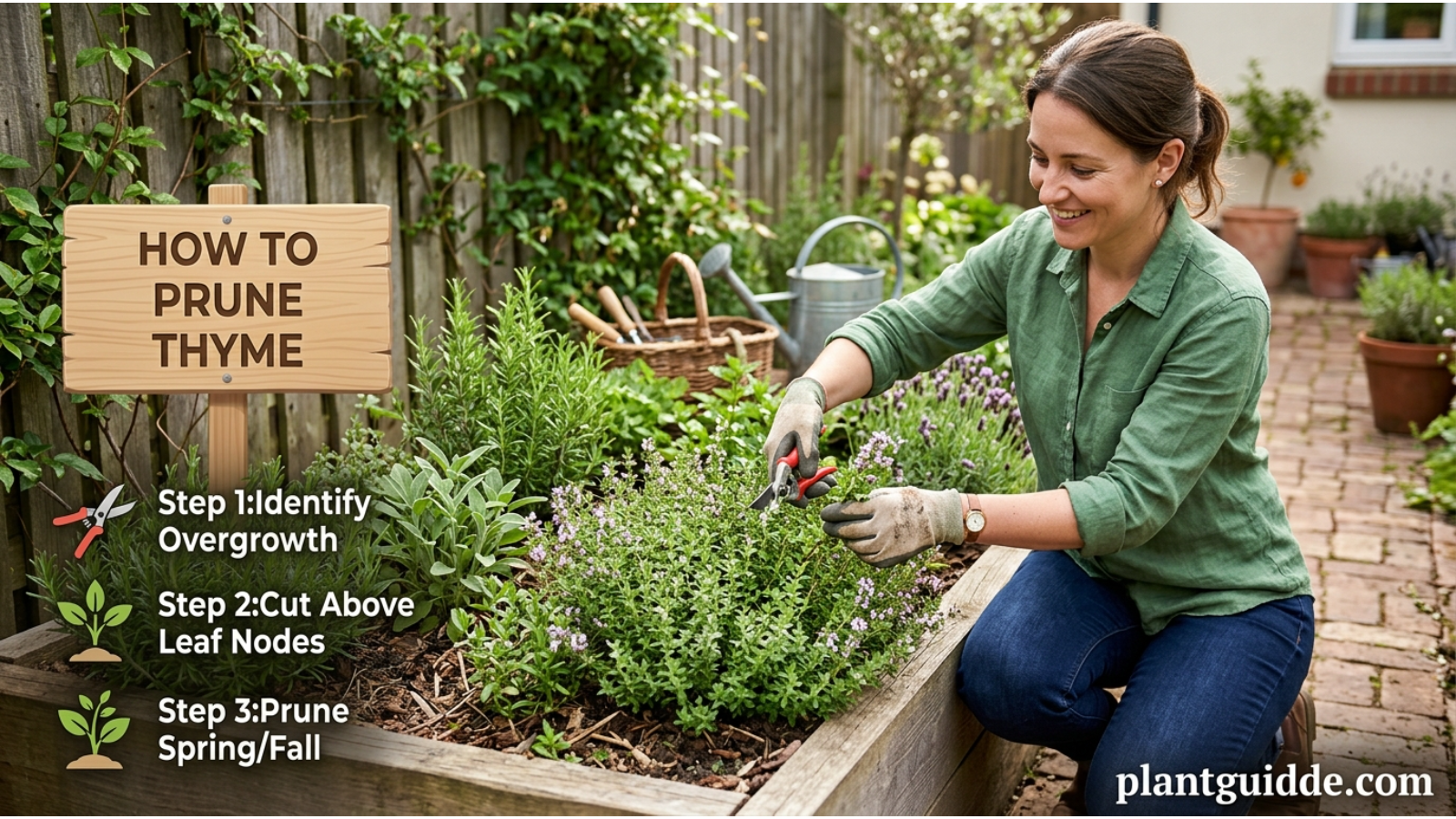
How to Prune Thyme
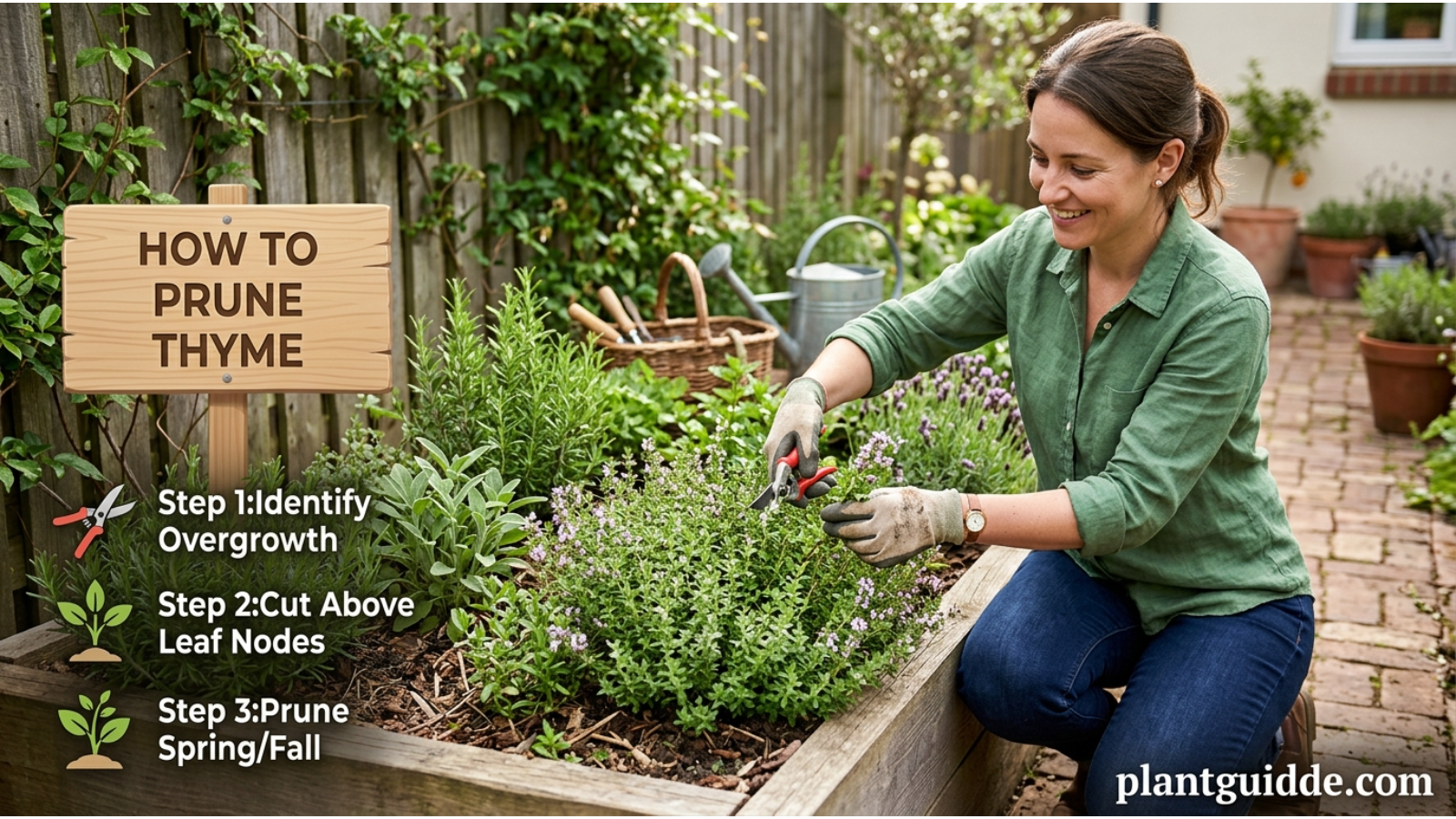
Regular harvesting is one of the easiest ways to keep thyme productive and attractive.
Use clean scissors or pruning shears to cut stems above healthy leaf growth. Harvesting encourages branching and helps prevent the plant from becoming excessively leggy.
How Much Can You Cut?
Avoid repeatedly cutting deep into old, bare, woody portions of the plant.
Instead, concentrate harvesting on green, actively growing stems.
A useful approach is to harvest smaller amounts regularly rather than waiting until the plant becomes extremely large and then removing a large portion at once.
When and How to Harvest Thyme
You can harvest thyme throughout the growing season as needed.
For culinary use:
- Select healthy, non-damaged stems.
- Cut them with clean scissors.
- Use the leaves fresh or remove them from the stems.
- Harvest regularly to encourage compact growth.
If you want to dry thyme, harvest stems when the foliage is healthy and aromatic, then dry them in a clean, well-ventilated location away from excessive moisture.
Always avoid harvesting so aggressively that very little healthy foliage remains.
Should You Let Thyme Flower?
Yes.
Thyme produces small flowers that can be attractive and useful for pollinators. Allowing some stems to flower is not inherently harmful.
If your primary goal is culinary harvesting and compact foliage, you can trim flowering stems when needed.
If you enjoy the ornamental value or want to support pollinating insects, allowing the plant to bloom can be worthwhile.
Repotting Thyme
Container-grown thyme may eventually need repotting if the roots become crowded or the existing soil has degraded.
Consider repotting when:
- Roots are densely filling the container
- Water runs through unusually quickly because the root mass is extremely compact
- Growth has slowed despite suitable light and watering
- The pot is clearly too small for the plant
When repotting, use fresh, well-draining soil and a container with drainage holes.
Do not automatically move a small thyme plant into a very large pot. A modest increase in container size is often easier to manage.
Propagating Thyme
Thyme can be propagated from stem cuttings, division, or seed, depending on the variety and your goals.
Propagation From Cuttings
Stem cuttings are often a practical way to produce a new plant that retains the characteristics of the parent plant.
Take a healthy non-flowering stem and remove the lower leaves. Place the cutting in an appropriate propagation medium and keep it lightly moist while roots develop.
The key is balance: the cutting needs enough moisture to establish roots but should not remain waterlogged.
Growing Thyme From Seed
Seed propagation takes more patience and may not produce plants identical to a particular named cultivar.
For gardeners who want a predictable clone of an existing thyme plant, cuttings are generally more useful.
Common Thyme Plant Problems
Thyme problems are often caused by environmental conditions rather than a mysterious disease.
Thyme Leaves Turning Yellow
Yellow leaves can have several causes, but persistent wet soil is one of the first things to investigate.
Check:
- How often you are watering
- Whether the soil is drying
- Whether the pot drains properly
- Whether the container is too large
- Whether the plant receives sufficient sunlight
If the soil is consistently wet, improve drainage and reduce watering rather than immediately adding fertilizer.
Thyme Turning Brown or Crispy
Brown, dry foliage can result from the opposite problem: prolonged lack of water, excessive heat, or damaged roots.
Check the soil before watering.
If the soil is bone dry and the plant is exposed to intense heat, it may need a deeper watering. If the soil is wet while foliage is deteriorating, investigate root and drainage problems instead.
Thyme Is Drooping
Drooping can be caused by both underwatering and root stress from excessive moisture.
This is why simply watering a drooping thyme plant can sometimes make the problem worse.
Check the soil first.
- Very dry soil: dehydration may be responsible.
- Wet soil: root stress or poor drainage is more likely.
- Wet soil + yellowing/soft growth: investigate overwatering and root problems.
Thyme Is Leggy
Leggy growth usually points toward insufficient light or inadequate pruning.
Move the plant to a brighter location and trim healthy stems to encourage branching.
If the plant has been growing in low light for a long time, improving light is more important than simply pruning it heavily.
Thyme Is Not Growing Much
Slow growth may be completely normal during unfavorable seasons, but persistent poor growth can indicate:
- Insufficient sunlight
- Poor drainage
- Root problems
- Very small containers
- Nutrient depletion
- Temperature stress
- Excessive harvesting
Look at the entire growing environment instead of assuming fertilizer is the answer.
Common Thyme Plant Care Mistakes
Watering on a Schedule
Giving thyme water every few days simply because it is your routine can keep the soil unnecessarily wet.
Better approach: Check the soil and plant conditions first.
Using Heavy Potting Soil
A dense mix can hold too much moisture around the roots.
Better approach: Use a light, well-draining growing medium.
Growing Thyme in Low Light
Thyme may survive for a while in mediocre indoor light, but survival is not the same as strong growth.
Better approach: Give it the brightest practical location.
Using a Pot Without Drainage
A decorative container without a drainage hole can trap excess water.
Better approach: Use a nursery pot with drainage holes inside a decorative cover, or choose a container designed to drain.
Overfertilizing
More fertilizer does not automatically mean more flavorful or healthier thyme.
Better approach: Correct light, soil, and watering first, then fertilize lightly only when appropriate.
Cutting Into Old Woody Growth
Severe pruning into old, leafless wood can leave thyme struggling to regenerate.
Better approach: Regularly harvest green growth before the plant becomes excessively woody.
A Simple Weekly Thyme Care Routine
Thyme doesn’t need a complicated maintenance schedule.
Once a week, quickly check:
- Light: Is the plant still receiving enough direct sunlight?
- Soil: Has the soil dried sufficiently before the next watering?
- Drainage: Is water escaping freely from the container?
- Growth: Are stems becoming thin or stretched?
- Foliage: Are leaves yellowing, browning, or becoming unusually soft?
- Pruning: Is light harvesting needed to maintain compact growth?
The actual work may take only a few minutes.
The important part is noticing changes early rather than trying to rescue a severely stressed plant later.
Thyme Care by Growing Location
| Growing location | Main priority | Common risk |
|---|---|---|
| Sunny garden | Drainage and sunlight | Wet soil |
| Raised bed | Well-drained soil | Overwatering |
| Outdoor container | Sun and moisture monitoring | Rapid drying |
| Indoor windowsill | Strong light | Insufficient sunlight |
| Kitchen herb garden | Light and airflow | Overwatering |
| Rock garden | Drainage and sun | Usually minimal if established |
How to Keep Thyme Healthy Long Term
The best long-term strategy is to imitate the conditions thyme naturally prefers rather than constantly correcting problems.
Give the plant:
- Plenty of sunlight
- Fast-draining soil
- A container with drainage if grown in a pot
- Water only when the soil has dried appropriately
- Good airflow
- Light, occasional feeding rather than heavy fertilization
- Regular harvesting
- Protection from prolonged waterlogging
One especially useful principle is to water the soil, not the calendar. Thyme’s water requirements change with weather, sunlight, pot size, and season.
When to Replace a Thyme Plant
Thyme is perennial, but individual plants can become increasingly woody and less productive with age.
Thyme plant care a plant has extensive dead wood, poor regeneration, and very little healthy green growth despite good conditions, replacing it or propagating younger plants may be more practical than continually trying to rejuvenate it.
This is also a good reason to propagate healthy thyme before an older plant declines.
FAQs:
How often should I water thyme?
Water thyme when the soil has dried sufficiently rather than following a strict schedule. Water thoroughly, then allow excess water to drain. Plants in hot, sunny containers may need watering more frequently than indoor plants.
Does thyme need full sun?
Yes. Thyme generally performs best with plenty of direct sunlight, ideally around 6–8 hours daily. Insufficient light can result in weak, stretched growth and reduced vigor.
Can thyme grow indoors?
Yes. Thyme can grow indoors when placed in a very bright location. A sunny windowsill is ideal, while a grow light may be necessary when natural light is inadequate.
Why is my thyme turning yellow?
Persistent yellowing can be associated with excessive moisture, poor drainage, insufficient light, or other growing stresses. Check the soil moisture and drainage first, especially if the plant is being watered frequently.
Can thyme grow in pots?
Absolutely. Thyme is well suited to containers as long as the pot has drainage and the growing medium drains quickly. Avoid oversized containers that stay wet for long periods.
Conclusion
Successful thyme plant care is largely about resisting the temptation to overdo things. Give thyme strong sunlight, fast-draining soil, good airflow, and water only when the soil has dried appropriately. Regular harvesting helps maintain useful, compact growth, while excessive watering and heavy feeding are more likely to create problems than solve them.
If your thyme is struggling, start with the basics: check the light, feel the soil, inspect drainage, and then adjust your care. Those four checks can often reveal the real problem before you reach for fertilizer or other treatments.
Internal Link Opportunities: Consider linking this guide to related articles such as How to Grow Herbs Indoors, Best Herbs for a Sunny Windowsill, How Often Should You Water Herbs?, and individual guides for rosemary, oregano, basil, and mint.

Asad Mumtaz is a dedicated plant enthusiast and gardening writer with a passion for helping people care for their plants successfully. He specializes in plant care guides, indoor gardening, and practical growing tips for all skill levels. His content focuses on making gardening simple, enjoyable, and rewarding. Through his work, Asad shares reliable advice to help readers create thriving green spaces.