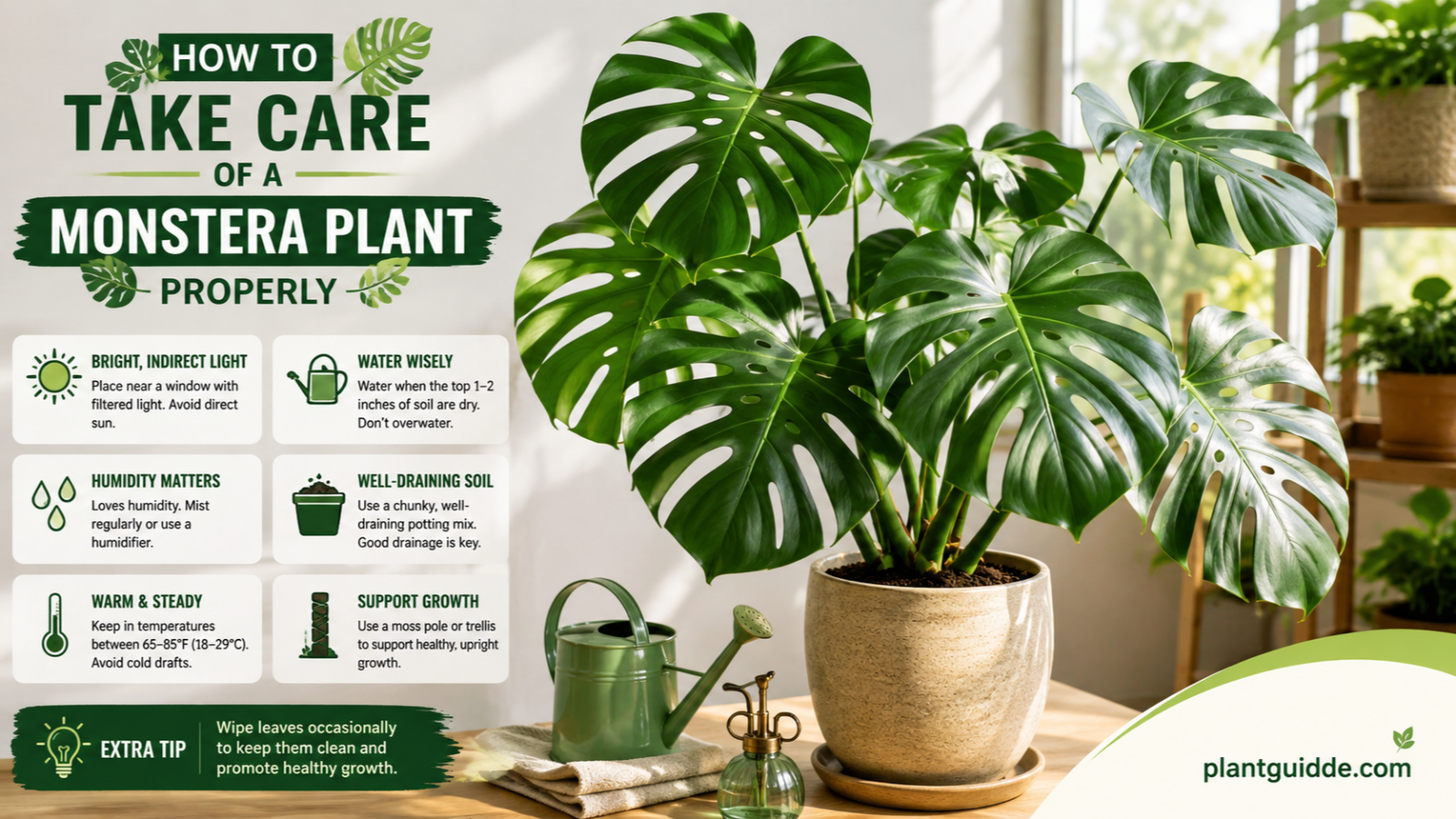
Few houseplants change the look of a room as dramatically as a healthy Monstera. Its large, glossy leaves, natural splits, and tropical growth habit make it a favorite for both beginners and experienced indoor gardeners. But knowing how to take care of a monstera plant involves more than putting it near a window and watering it once a week.
Monsteras respond strongly to their environment. Too little light can produce slow, stretched growth and smaller leaves. Too much direct sun can scorch exposed foliage. Overwatering can damage the roots, while letting the plant become extremely dry can cause curling, drooping, and crispy edges.
This guide explains how to take care of a monstera plant from the basics of light, water, soil, humidity, and temperature to more advanced issues such as aerial roots, leaf fenestration, pruning, repotting, support, pests, and root rot.
Quick Answer
To learn how to take care of a monstera plant, provide bright indirect light, well-draining soil, moderate watering, warm temperatures, and good humidity. Let the upper portion of the soil dry before watering again rather than following a rigid schedule. Give the plant room to climb, rotate it occasionally for even growth, and watch its leaves and roots for early signs of stress.
Understanding the Monstera Plant
The name Monstera commonly refers to tropical plants in the genus Monstera, with Monstera deliciosa being one of the most widely grown houseplants.
In its natural environment, Monstera grows as a climbing tropical plant. Rather than behaving like a compact shrub, it uses surrounding vegetation and structures for support. This explains several things that can confuse indoor growers:
- It naturally wants to climb.
- Aerial roots are normal.
- Mature leaves can become dramatically larger.
- Leaf splits and holes become more pronounced as the plant matures.
- A sturdy support can produce a more upright, substantial plant.
Understanding this growth habit is one of the most useful pieces of information for learning how to take care of a monstera plant.
A Monstera that is constantly forced to trail across the floor may survive, but it may not develop the same form as one given appropriate vertical support.
Image Suggestion: Botanical illustration showing a Monstera’s leaves, stem, nodes, aerial roots, and climbing growth habit.
Monstera Care at a Glance
| Care factor | What a Monstera generally prefers | What to watch for |
|---|---|---|
| Light | Bright, indirect light | Scorching or weak, stretched growth |
| Water | Thorough watering followed by partial drying | Constantly wet or bone-dry soil |
| Soil | Airy, well-draining growing mix | Compaction and poor drainage |
| Humidity | Moderate to higher household humidity | Persistent crispy edges |
| Temperature | Warm, stable conditions | Cold drafts and sudden changes |
| Support | Moss pole, trellis, or sturdy stake | Leaning or sprawling growth |
| Fertilizer | Regular feeding during active growth | Weak growth or fertilizer buildup |
| Pot | Drainage holes are essential | Water sitting around roots |
| Pruning | Remove damaged or unwanted growth | Excessive cutting |
| Repotting | When roots outgrow the container or soil deteriorates | Severely root-bound conditions |
The most important point is that these factors interact. Increasing watering without improving light, for example, can make problems worse rather than better.
Give Your Monstera the Right Light
Light is one of the biggest factors determining how successfully a Monstera grows indoors.
What light does a Monstera need?
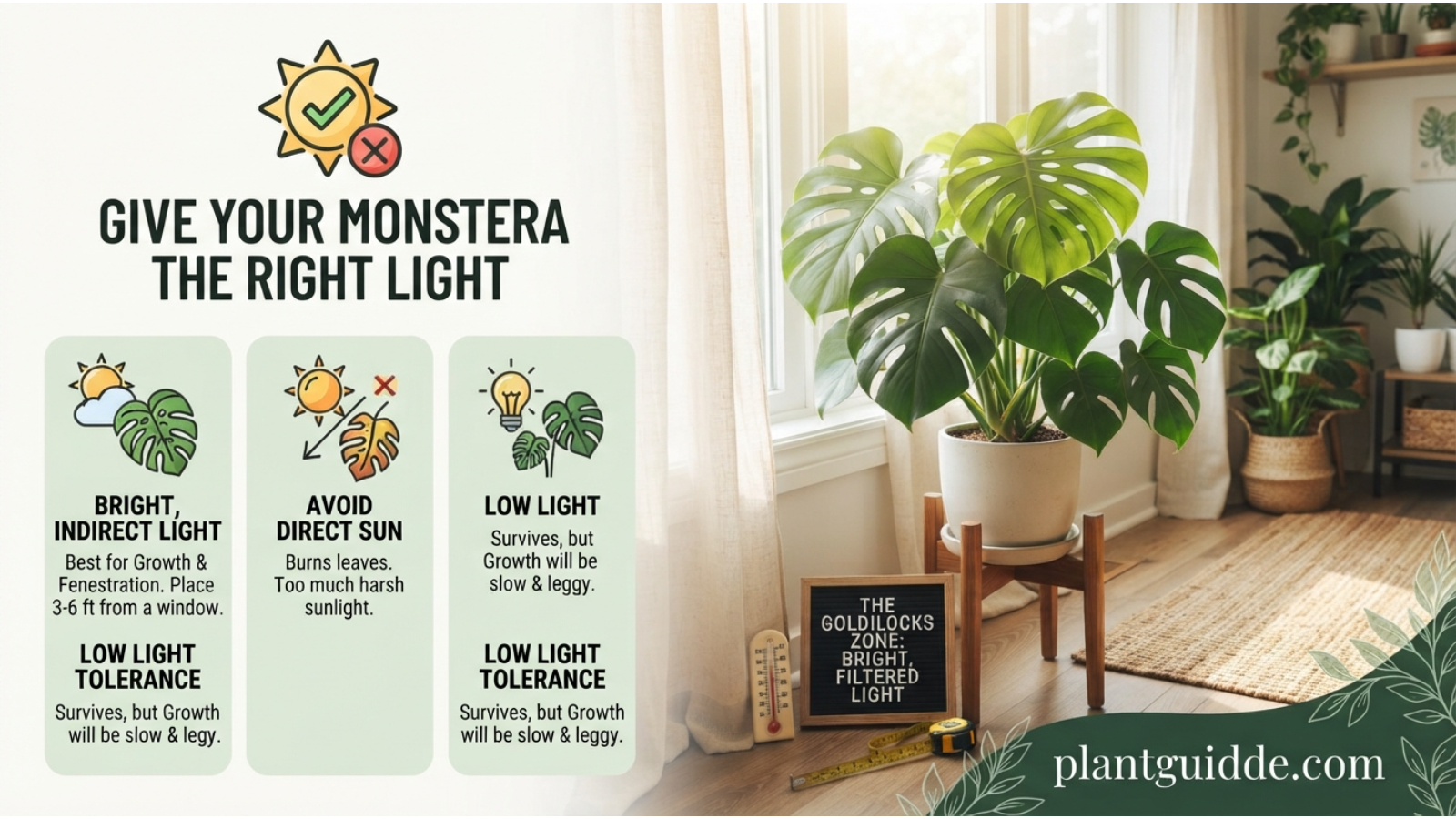
A Monstera generally performs best in bright, indirect light. It can tolerate lower light than some tropical plants, but lower light usually means slower growth and less impressive foliage.
A spot close to a bright window can work extremely well, provided intense direct sunlight is filtered or limited.
An east-facing window is often a convenient option because it can provide bright morning light. A bright south- or west-facing window may also work, but the plant may need to be positioned farther from the glass or protected from harsh direct afternoon sunlight.
Signs your Monstera needs more light
Look for:
- Long spaces between leaves along the stem
- Slow production of new leaves
- Smaller new leaves
- Growth leaning strongly toward a window
- Weak or stretched stems
Signs the light may be too intense
You may notice:
- Bleached-looking patches
- Tan or brown scorched areas
- Crispy sections on leaves
- Sudden damage after moving the plant into strong sunlight
One important practical lesson is to change light conditions gradually. A Monstera that has been living in relatively low light can react badly when moved directly into several hours of intense sunlight.
Image Suggestion: Monstera positioned near a bright window, showing the difference between filtered light and harsh direct afternoon sunlight.
Water Your Monstera Based on the Soil
Watering is where many beginners struggle with how to take care of a monstera plant.
There is no universal “water every seven days” rule because indoor conditions vary dramatically. A plant in a bright, warm room may use water much faster than one sitting in a dim, cool corner.
Instead, check the growing medium.
When should you water a Monstera?
Allow the upper portion of the soil to dry before watering again. The exact drying point depends on factors such as:
- Pot size
- Soil composition
- Light exposure
- Temperature
- Humidity
- Root health
- Season
- Plant size
When the soil has dried sufficiently, water thoroughly until excess water flows from the drainage holes.
Then empty any water collected in the saucer or outer container.
Why overwatering is so dangerous
Overwatering does not simply mean giving a plant “too much water” in one event. A more common problem is watering too frequently while the root zone remains wet for too long.
Roots need access to oxygen. Permanently saturated soil reduces air spaces around the roots and can create conditions that encourage root deterioration.
Care of a Monstera Plant is why a Monstera can have wet soil and still look dehydrated: damaged roots may no longer function properly.
A practical watering test
Before watering, check several centimeters below the surface rather than relying only on the appearance of the top layer.
Care of a Monstera Plant the soil is still noticeably wet deeper down, give it more time.
Care of a Monstera Plant it has dried substantially and the plant is otherwise healthy, water thoroughly.
Expert Tip: Do not confuse drooping with an automatic need for water. A drooping Monstera can be thirsty, but root problems can produce similar symptoms.
Choose an Airy, Well-Draining Soil Mix
Good Monstera soil should retain enough moisture for the roots while still allowing excess water and air to move through the root zone.
A heavy garden soil that stays wet for a long time is usually a poor choice for indoor Monstera growing.
A suitable mix can contain ingredients such as:
- Quality indoor potting mix
- Orchid bark
- Perlite or another aerating component
- Coco coir or similar moisture-retaining material
The exact recipe does not need to be complicated.
The goal is to create a growing medium that is moisture-retentive but not suffocating.
Why soil structure matters more than a recipe
Two people can use the same ingredients and get different results because particle size, pot dimensions, watering habits, and environmental conditions all affect how quickly soil dries.
For example, a small Monstera in a large container filled with dense, wet soil may remain damp far longer than expected.
That combination can create more risk than simply choosing the “wrong” potting mix.
Image Suggestion: Close-up diagram comparing compact, waterlogged soil with an airy Monstera potting mix containing bark and perlite.
Use a Pot With Drainage Holes
A drainage hole is not a luxury for Monstera—it is one of the simplest ways to reduce watering problems.
The pot should allow excess water to escape freely.
You can place a nursery pot with drainage holes inside a decorative cachepot if you want a cleaner appearance. Just remember to empty the outer container after watering if water accumulates there.
Should you put rocks in the bottom of the pot?
A common gardening myth suggests adding a thick layer of gravel or rocks beneath the soil to improve drainage.
For a typical houseplant container, this does not solve the underlying problem of poor drainage. The more useful approach is to use an appropriate potting mix and a container with a drainage opening.
Maintain Suitable Humidity
Monsteras originate from humid tropical environments, so they generally appreciate moderate to higher humidity indoors.
However, you do not need to turn your entire home into a greenhouse.
A healthy Monstera can often adapt to ordinary indoor conditions, especially when other factors—particularly watering, temperature, and light—are stable.
When should you increase humidity?
Higher humidity can be particularly useful when:
- Leaf edges repeatedly become crispy
- Indoor heating makes the air very dry
- The plant is growing actively
- New leaves struggle to unfurl
- The surrounding air is consistently dry
A humidifier is generally more reliable than repeatedly misting the foliage.
Misting may temporarily increase moisture around the leaves, but it does not necessarily provide sustained humidity.
Practical Tip: If you increase humidity, maintain reasonable airflow too. A constantly damp, stagnant environment is not the goal.
Keep Your Monstera Warm and Stable
Monsteras prefer warm conditions and can react poorly to cold temperatures and sudden environmental changes.
Keep the plant away from:
- Cold drafts
- Frequently opened exterior doors
- Very cold windows during winter
- Strong heating vents
- Air-conditioning outlets
Temperature stability matters because a plant can experience stress even when the average room temperature seems acceptable.
Care of a Monstera Plant your Monstera suddenly develops damage after being moved, consider what changed, not only how much water it received.
Give Your Monstera Something to Climb
This is one of the most overlooked parts of how to take care of a monstera plant.
Monstera is naturally adapted to climbing.
A mature plant can become heavy and difficult to manage if it is allowed to sprawl without support.
Useful supports include:
- Moss poles
- Coir poles
- Trellises
- Sturdy stakes
- Other stable vertical supports
Attach the stem loosely rather than tightly constricting it.
Why support can improve the plant’s appearance
When a Monstera climbs, its growth can become more vertical and organized. Mature foliage may also become more impressive as the plant develops.
A support does not magically create mature leaves, though. Adequate light, healthy roots, age, nutrition, and overall growing conditions still matter.
Image Suggestion: Step-by-step visual showing a young Monstera being attached loosely to a moss pole as it grows upward.
Understand Aerial Roots
Aerial roots can look strange if you are new to Monsteras.
They are completely normal.
These roots develop from nodes along the stem and are part of the plant’s natural climbing strategy. In a tropical environment, they can help the plant anchor itself and interact with the surrounding environment.
Should you cut Monstera aerial roots?
Usually, there is no need to cut healthy aerial roots simply because they are visible.
You can:
- Guide them toward a suitable support
- Allow them to grow naturally
- Redirect them into the potting mix if appropriate
- Trim them only when they are genuinely causing a practical problem
Do not mistake aerial roots for evidence that something is wrong with your plant.
Feed Your Monstera During Active Growth
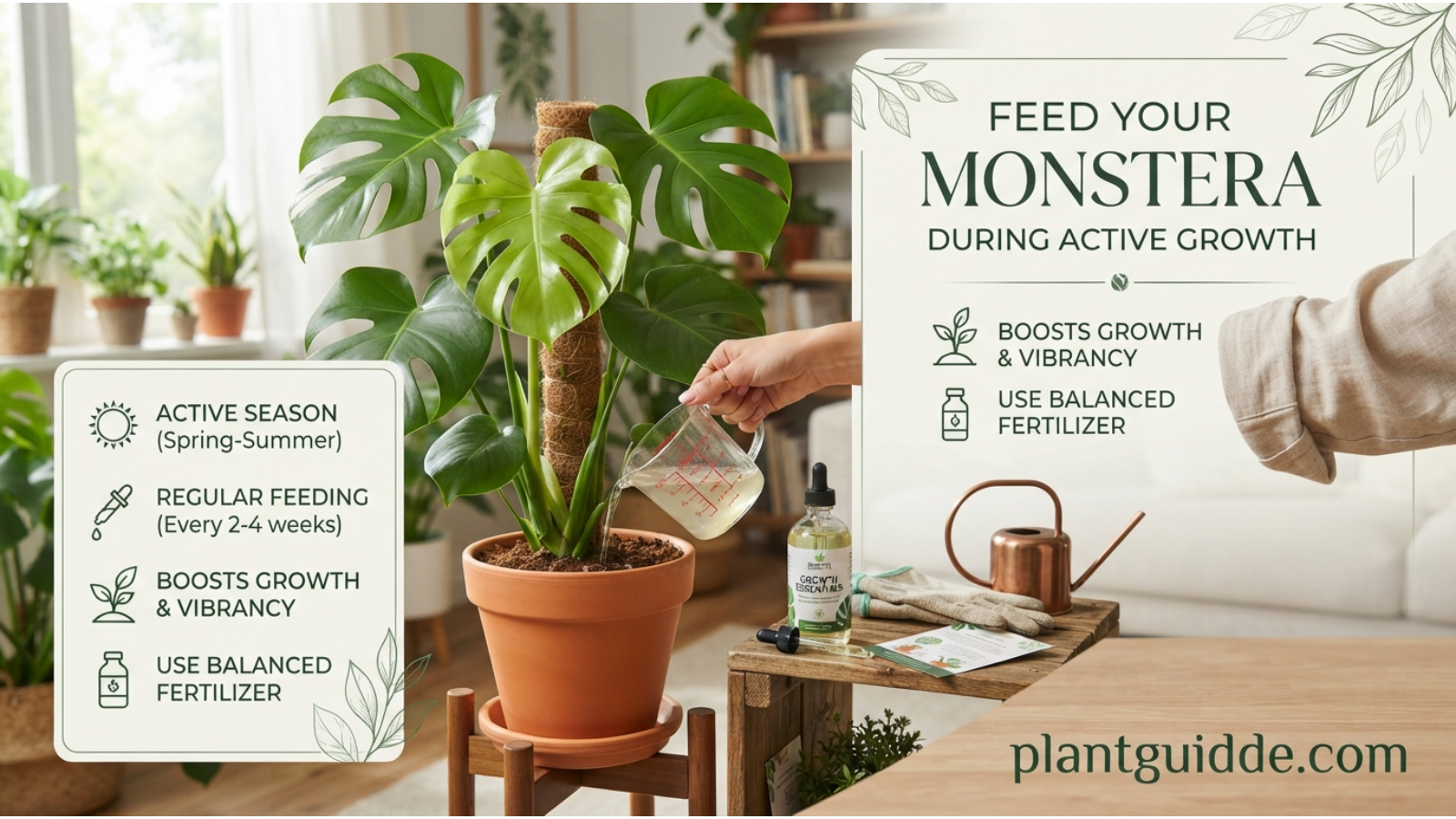
Monsteras need nutrients to produce new foliage and maintain healthy growth.
During active growth, a balanced houseplant fertilizer used according to its label directions can support development.
Avoid the common mistake of assuming that more fertilizer means faster growth.
Excess fertilizer can contribute to salt buildup in the growing medium and may damage roots.
A plant that is barely growing because of inadequate light will not necessarily become healthy simply because you add more fertilizer.
Expert Insight: Before reaching for fertilizer, check the basics first: light, roots, water, soil, and temperature.
Rotate the Plant for More Even Growth
Monsteras naturally grow toward available light.
If the plant stays in one position for a long time, it may become noticeably one-sided.
Rotating the pot periodically can help distribute light more evenly and produce a more balanced appearance.
Do not rotate it constantly or make dramatic changes to its environment. A simple occasional adjustment is usually enough.
Clean the Leaves Carefully
Large Monstera leaves can collect dust, especially indoors.
A layer of dust can make the foliage look dull and may interfere with normal leaf function.
To clean the leaves:
- Use a soft, damp cloth.
- Support the leaf from underneath.
- Gently wipe the surface.
- Avoid aggressive rubbing.
- Allow the foliage to dry naturally.
Avoid relying on commercial leaf-shine products simply to make leaves glossy. Healthy Monstera foliage already has its own natural appearance.
Pruning a Monstera Without Damaging It
Pruning can control size, remove damaged foliage, and help shape the plant.
Use clean, sharp tools when cutting.
Remove:
- Completely dead leaves
- Severely damaged foliage
- Unwanted growth that interferes with the plant’s shape
- Diseased material when appropriate
Avoid removing large amounts of healthy foliage simply because the plant looks crowded.
Remember that leaves are the plant’s energy-producing surfaces. Excessive pruning can slow recovery and growth.
When and How to Repot a Monstera
Monsteras do not need to be repotted on a strict annual schedule.
Instead, look at the plant and its root system.
Repotting may be appropriate when:
- Roots are densely circling the container
- Roots are emerging extensively from drainage holes
- The potting mix has broken down significantly
- Water passes through unusually quickly because the root mass has filled the container
- Growth is being restricted by severe root crowding
- The current container is unstable for the size of the plant
How to repot
Choose a container only moderately larger than the existing root system.
A huge pot is not automatically better.
Excess soil around a relatively small root system can remain wet for a long time, increasing the risk of root problems.
After repotting, return the plant to a suitable location and avoid repeatedly disturbing it while it adjusts.
Image Suggestion: Monstera repotting sequence showing root-bound roots, appropriate new pot size, fresh soil, and final placement.
Monstera Leaf Splits: What They Really Mean
One of the biggest questions beginners ask is why their Monstera does not have dramatic holes and splits.
The answer is that young Monstera leaves often look very different from mature foliage.
Fenestrations tend to become more characteristic as the plant matures and grows under suitable conditions.
Several factors influence leaf development, including:
- Plant maturity
- Species or variety
- Light
- Overall health
- Growing conditions
- Climbing behavior
A young plant should not be judged against photographs of a mature specimen.
Does more fertilizer create split leaves?
Not by itself.
If the plant lacks adequate light or is otherwise stressed, simply adding fertilizer will not force it to produce mature, highly fenestrated foliage.
Focus first on creating the conditions required for healthy growth.
Monstera Troubleshooting: What the Leaves Are Telling You
Leaves can provide useful clues, but symptoms often overlap. A brown leaf does not automatically mean one specific problem.
Use the whole growing environment to diagnose the issue.
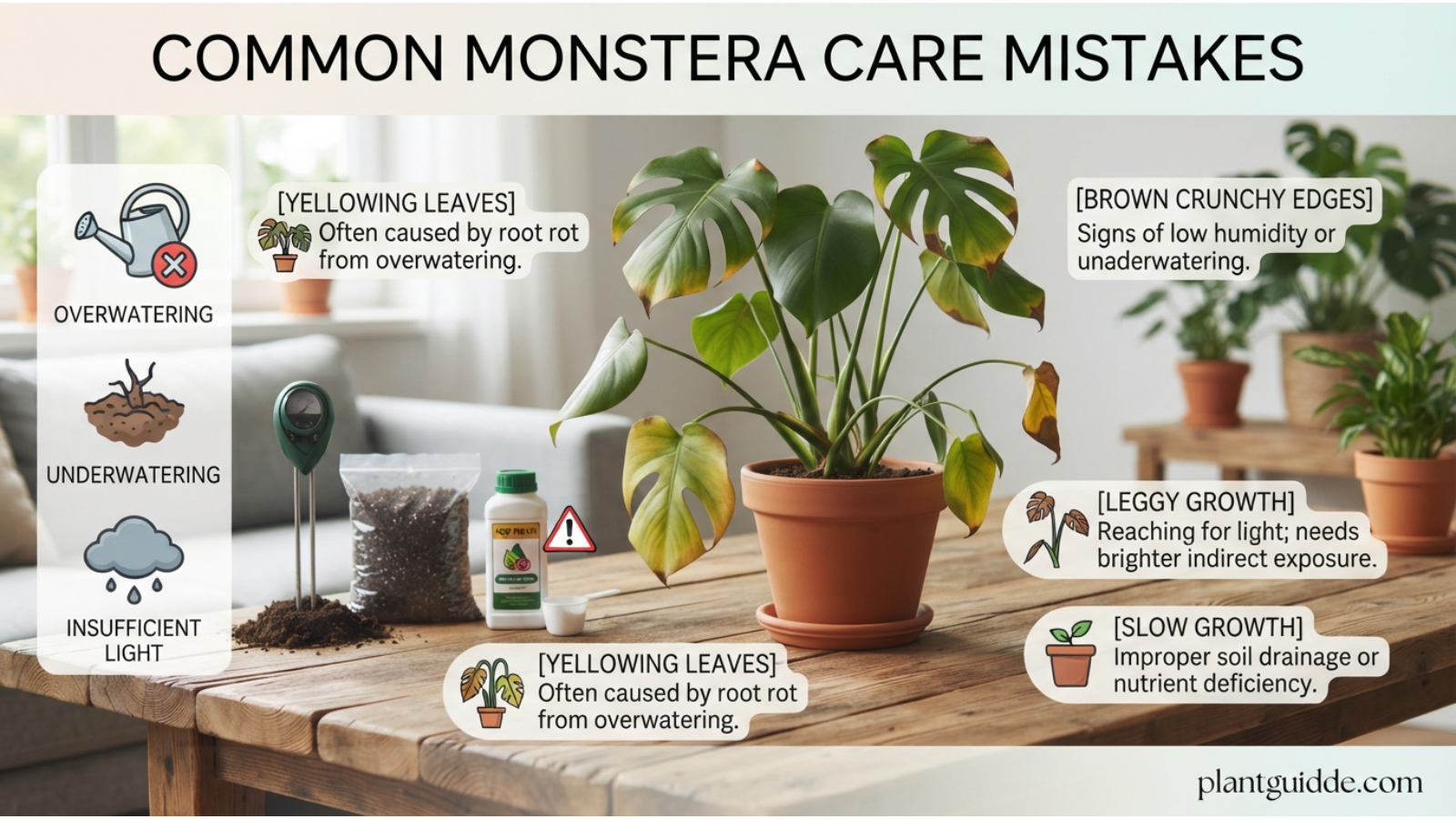
Brown leaf tips
Possible causes include:
- Low humidity
- Inconsistent watering
- Excessive dryness
- Salt buildup
- Root problems
- Environmental stress
Check the soil moisture, watering pattern, humidity, and roots before changing everything at once.
Yellow leaves
Yellowing can occur naturally as older leaves age, but widespread or sudden yellowing deserves investigation.
Potential causes include:
- Excess moisture
- Poor drainage
- Root stress
- Inadequate light
- Nutritional problems
- Environmental changes
If the soil stays wet for a long time, investigate the roots before simply adding fertilizer.
Curling leaves
Curling can be associated with:
- Underwatering
- Excessive heat
- Low humidity
- Root problems
- Sudden environmental stress
Check the soil first rather than guessing.
Drooping leaves
A drooping Monstera may be thirsty, but drooping can also occur when roots are unhealthy.
Compare the plant’s condition with the soil:
Dry soil + drooping: dehydration becomes more likely.
Wet soil + drooping: investigate drainage and root health before watering again.
Brown or bleached patches
If damage is concentrated on the side facing strong sunlight, excessive direct light may be involved.
If damage appears alongside persistently wet soil, root stress may deserve more attention.
Image Suggestion: Monstera troubleshooting infographic showing brown tips, yellow leaves, curling leaves, sun damage, and root-rot symptoms with likely causes.
How to Recognize Possible Root Rot
Root problems are particularly important because they can remain hidden below the soil while the leaves show confusing symptoms above ground.
Warning signs may include:
- Soil remaining wet for unusually long periods
- Persistent wilting despite wet soil
- Yellowing leaves
- Weak growth
- Soft or deteriorating roots
- Unpleasant odor from severely compromised soil
If you suspect root rot, remove the plant carefully and inspect the root system.
Healthy roots should generally feel firm rather than mushy and deteriorating.
Remove severely damaged roots with clean tools, refresh the growing medium, and correct the environmental conditions that caused the prolonged moisture problem.
Simply repotting without changing the watering or drainage issue may allow the problem to return.
Common Monstera Care Mistakes
1. Watering on a fixed calendar
“Every Sunday” sounds convenient, but plants do not consume water according to the calendar.
Check the soil instead.
2. Keeping the soil permanently wet
Moisture is necessary, but permanently saturated roots can become unhealthy.
3. Putting the plant in a dark corner
Monsteras tolerate lower light, but tolerance does not mean optimal growth.
4. Moving it suddenly into intense sunlight
A plant adapted to lower light can develop leaf scorch when exposed abruptly to strong direct sun.
5. Using a pot that is far too large
A giant pot can hold excess moisture around a relatively small root system.
6. Cutting every aerial root
Aerial roots are a normal part of Monstera growth.
7. Fertilizing a stressed plant without diagnosing the problem
Nutrients cannot compensate for poor roots, inadequate light, or chronic overwatering.
8. Expecting young plants to have huge fenestrated leaves
Maturity matters. Give the plant time and appropriate conditions.
9. Ignoring the underside of leaves
Pests often hide beneath foliage and around stems. Inspect these areas regularly.
Monstera Pests to Watch For
Indoor Monsteras can occasionally attract pests such as:
- Spider mites
- Mealybugs
- Scale insects
- Thrips
Early detection makes control easier.
When inspecting your plant, look closely at:
- Leaf undersides
- New growth
- Leaf joints
- Stems
- Areas where leaves overlap
If you notice sticky residue, fine webbing, tiny insects, distorted new growth, or unexplained speckling, inspect the plant more carefully.
Isolate a visibly infested houseplant from nearby plants while you determine the problem and begin appropriate treatment.
Seasonal Monstera Care
Your watering routine should change as indoor conditions change.
Spring and summer
With stronger light and warmer conditions, Monsteras may actively produce new growth and use water more quickly.
Check the soil more frequently rather than automatically increasing watering.
This is also typically the period when feeding is most useful for actively growing plants.
Fall and winter
Growth may slow because of reduced light and cooler conditions.
As the plant uses water more slowly, the soil may remain moist longer.
The mistake to avoid is maintaining a summer watering schedule throughout winter without checking the soil.
Practical rule: Let the plant’s environment determine your routine—not the calendar alone.
A Simple Monstera Care Routine
If you want a straightforward routine, use this checklist.
Every few days
Look at:
- Leaf condition
- Soil moisture
- New growth
- Signs of pests
During watering
Check the soil before adding water.
When it is sufficiently dry, water thoroughly and allow excess water to drain.
Every few weeks
Inspect:
- Leaf undersides
- Stems
- Aerial roots
- Overall plant shape
- Support system
Rotate the pot if growth is becoming heavily one-sided.
During active growth
Monitor whether the plant needs:
- Fertilizer
- Additional support
- More space
- Pruning of damaged material
This routine is more reliable than trying to memorize a rigid Monstera watering schedule.
How to Make a Monstera Grow Larger
If your goal is a larger, more mature-looking Monstera, focus on the entire growing system rather than one “growth hack.”
Prioritize:
- Strong but appropriate light
- Healthy roots
- Consistent watering
- Airy soil
- Adequate nutrition
- Warm conditions
- Vertical support
- Enough time for maturity
A support pole can encourage the plant to grow upward, but it cannot compensate for poor light or unhealthy roots.
Likewise, fertilizer can support growth but cannot replace sunlight.
The fastest way to improve a struggling Monstera is often to identify the limiting factor rather than adding more of everything.
Advanced Tip: Look at the Node, Not Just the Leaf
Care of a Monstera Plant you plan to propagate or prune a Monstera, learn to identify the node.
A node is the section of the stem where structures such as leaves, buds, and aerial roots can emerge.
A leaf by itself is not necessarily enough for successful propagation. A viable cutting generally needs an appropriate node containing the growth point.
This is an important distinction for anyone moving from basic Monstera care into propagation.
Monstera Propagation Basics
Healthy Monstera plants can be propagated from suitable stem cuttings.
A cutting should contain a viable node.
Depending on the method and cutting, propagation can be performed in:
- Water
- Moist growing medium
- Other appropriate propagation setups
The key is not simply obtaining a leaf. The node is what makes the cutting capable of producing new growth.
Keep newly propagated cuttings in suitable light and avoid allowing them to remain excessively wet.
Once roots and new growth are developing well, the young plant can be transitioned into an appropriate growing medium.
What to Do First When Your Monstera Looks Unhealthy
When several symptoms appear at once, do not change ten things simultaneously.
Use this order:
Step 1: Check the soil
Is it extremely dry, appropriately moist, or staying wet for too long?
Step 2: Check the light
Is the plant receiving enough bright light for healthy growth?
Step 3: Check the roots if the symptoms do not make sense
Especially investigate roots when the plant is drooping while the soil remains wet.
Step 4: Inspect for pests
Check the undersides of leaves and new growth.
Step 5: Look for recent environmental changes
Ask:
- Was the plant moved?
- Did the temperature change?
- Did watering habits change?
- Was it recently repotted?
- Was it suddenly exposed to stronger sunlight?
Step 6: Change one or two major factors first
This makes it easier to determine what actually helped.
This diagnostic approach is often more effective than treating every symptom separately.
FAQs,
How often should I water a Monstera?
There is no universal schedule. Water when the upper portion of the growing medium has dried sufficiently, then water thoroughly and allow excess water to drain. Light, temperature, humidity, pot size, and soil all affect how quickly the plant dries.
Does Monstera need direct sunlight?
Monstera generally prefers bright, indirect light. Some gentle direct sunlight can be tolerated, but intense exposure—especially after a sudden transition—can scorch the leaves.
Why are my Monstera leaves turning yellow?
Yellow leaves can have several causes, including natural aging, excessive moisture, poor drainage, root stress, inadequate light, or other environmental problems. Check the soil and root conditions before assuming the plant needs fertilizer.
Why are my Monstera leaves curling?
Curling can occur because of underwatering, dry conditions, heat, low humidity, root problems, or environmental stress. Check soil moisture first and consider the plant’s overall conditions.
Why doesn’t my Monstera have splits?
Young Monsteras commonly produce less-fenestrated leaves. Fenestration generally becomes more characteristic as the plant matures under suitable growing conditions.
Should I cut off aerial roots?
Healthy aerial roots are normal and usually do not need to be removed. They can be guided toward a support or managed if they become inconvenient.
Does Monstera need a moss pole?
It does not strictly require one to survive, but vertical support can be very useful because Monstera naturally has a climbing growth habit.
What is the best soil for Monstera?
Use an airy, well-draining mix that retains some moisture without remaining saturated. A combination of quality potting mix with materials such as bark and perlite can work well.
Should I mist my Monstera?
Misting is not essential for healthy Monstera growth. If indoor air is consistently dry, a humidifier generally provides more sustained humidity than occasional misting.
How do I make my Monstera grow faster?
Provide appropriate bright light, healthy roots, suitable watering, airy soil, adequate nutrition during active growth, warmth, and support. Growth speed depends on the plant’s genetics, maturity, and environment, so there is no single shortcut.
Can I keep a Monstera in a bedroom?
Yes, provided the room offers suitable light, temperature, and growing conditions. A bedroom location itself does not prevent a Monstera from growing successfully.
How do I know if my Monstera is overwatered?
Persistent wet soil, yellowing, drooping despite wet soil, slow growth, and deteriorating roots can indicate excessive moisture or root problems. Inspect the soil and roots rather than diagnosing overwatering from one symptom alone.
Related Topics Worth Reading
If this guide is part of a broader plant-care website, useful internal links could include:
- Monstera propagation guide — for readers ready to create new plants from stem cuttings.
- Monstera yellow leaves troubleshooting — for diagnosing discoloration.
- Monstera brown leaves guide — for investigating crispy edges and brown patches.
- Best soil for Monstera — for readers who need help building or choosing a growing mix.
- How to propagate houseplants — a broader guide covering propagation techniques.
- Indoor plant watering guide — useful for beginners struggling with watering frequency.
- How to care for a pothos plant — a related beginner-friendly tropical houseplant topic.
These links should be added only where the supporting article genuinely expands on the reader’s question.
Conclusion
Learning how to take care of a monstera plant becomes much easier when you stop treating plant care as a fixed schedule and start responding to the plant’s environment.
Give your Monstera bright indirect light, an airy and well-draining growing medium, thorough but appropriately timed watering, warm conditions, and reasonable humidity. Keep an eye on the roots, provide climbing support as the plant matures, and inspect leaves regularly for pests or environmental stress.
Most importantly, learn to read the combination of symptoms. A yellow leaf, curling leaf, or drooping stem is a clue, not a complete diagnosis.
When you understand what your Monstera is telling you, routine care becomes simpler, problems are easier to catch early, and the plant has a much better chance of developing the large, healthy foliage that makes it such a striking houseplant.

Asad Mumtaz is a dedicated plant enthusiast and gardening writer with a passion for helping people care for their plants successfully. He specializes in plant care guides, indoor gardening, and practical growing tips for all skill levels. His content focuses on making gardening simple, enjoyable, and rewarding. Through his work, Asad shares reliable advice to help readers create thriving green spaces.