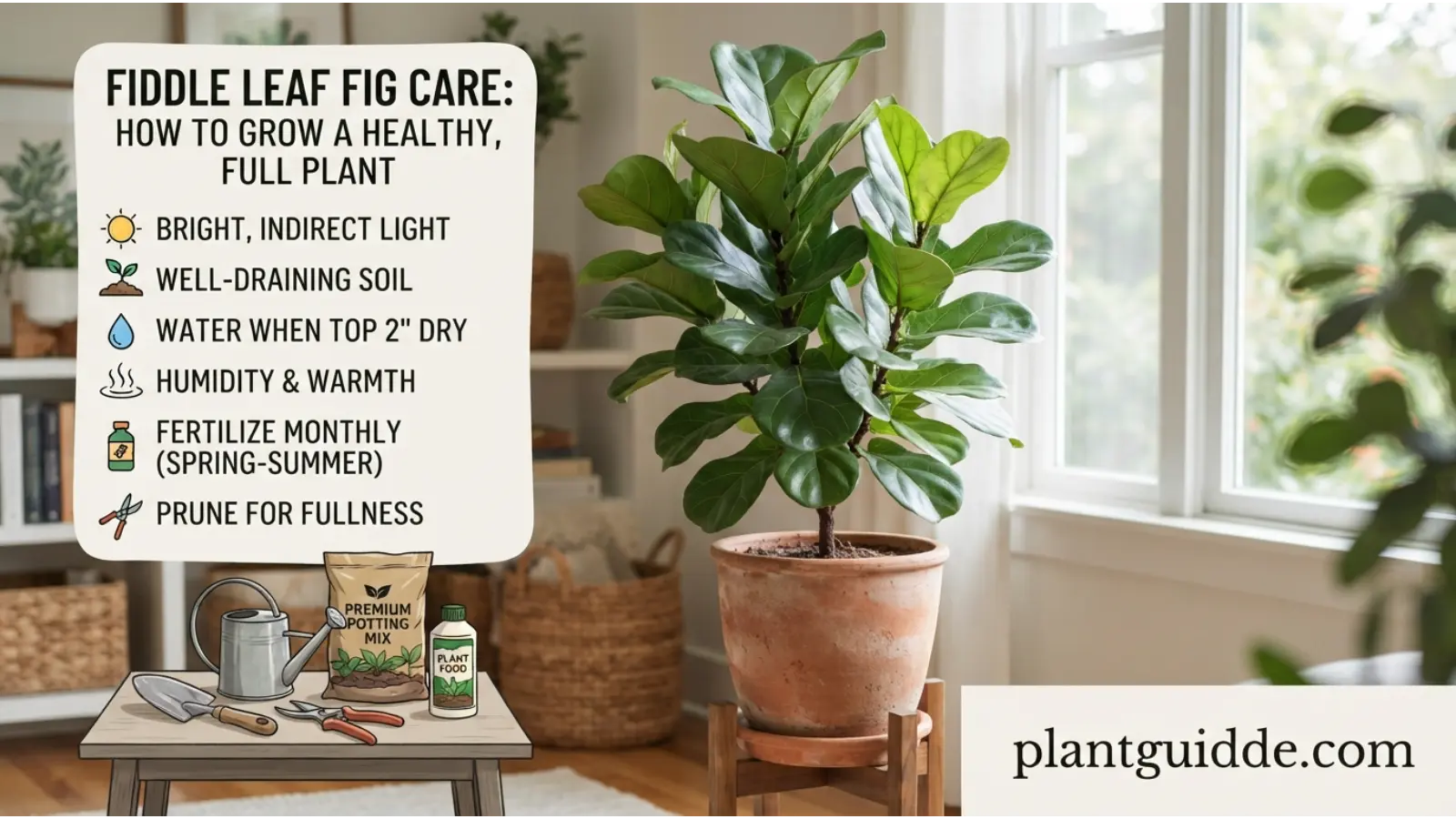
Fiddle leaf fig plant care (Ficus lyrata) are popular because their enormous, violin-shaped leaves can make a room feel instantly greener and more dramatic. They can also be surprisingly unforgiving when their growing conditions change too quickly.
The good news is that successful fiddle leaf fig plant care does not require constant attention. What matters more is consistency.
A plant receiving strong light but staying in soggy soil can struggle just as badly as one sitting in a dim corner. Likewise, moving it repeatedly, changing its watering routine, or exposing it to drafts can cause stress and leaf drop.
Once you understand how light, moisture, roots, temperature, humidity, and feeding work together, caring for a fiddle leaf fig becomes much more predictable.
Quick Answer
Fiddle leaf fig plant care is mainly about providing bright, consistent light, well-draining soil, careful watering, warmth, and moderate to high humidity. Let the upper portion of the soil dry before watering thoroughly, keep the plant away from cold drafts and sudden environmental changes, and give it enough space to grow. Fiddle leaf figs respond poorly to both constantly wet soil and repeated drought.
What Is a Fiddle Leaf Fig?
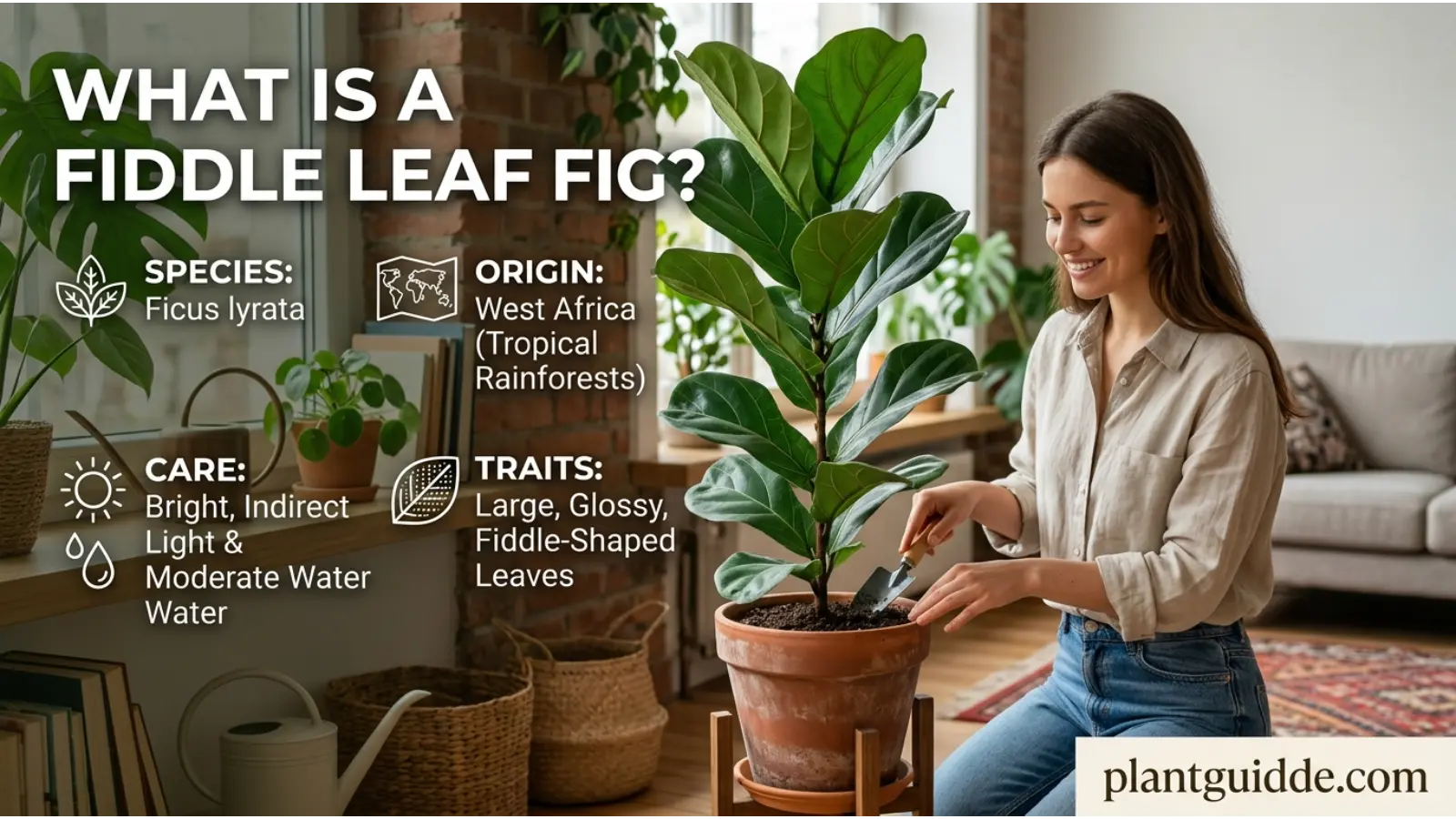
The fiddle leaf fig, botanically known as Ficus lyrata, is an evergreen member of the mulberry family, Moraceae. It is native to tropical regions of western and central Africa and is known for its large, glossy, fiddle-shaped leaves.
In its natural environment, it can become a substantial tree. Indoors, growth is naturally restricted by the container, available light, pruning, and overall growing conditions.
Its large leaves are part of what makes the plant attractive, but they also make problems easy to notice. Brown edges, yellowing, curling, drooping, leaf spots, or sudden leaf drop can quickly change its appearance.
Rather than treating each symptom as a separate problem, look at the plant’s entire environment.
Fiddle Leaf Fig Care Requirements at a Glance
| Care factor | What your plant generally needs |
|---|---|
| Light | Bright light; gradual exposure to some direct sun can be tolerated |
| Water | Thorough watering when the upper soil has dried sufficiently |
| Soil | Moisture-retentive but well-draining potting mix |
| Pot | Drainage holes are essential |
| Humidity | Moderate to high humidity is beneficial |
| Temperature | Warm, stable conditions away from cold drafts |
| Fertilizer | Regular feeding during active growth |
| Repotting | Usually every couple of years or when roots become crowded |
| Pruning | Useful for controlling height and encouraging branching |
| Cleaning | Wipe large leaves periodically to remove dust |
| Common pests | Scale, spider mites, thrips, mealybugs |
RHS guidance describes Ficus lyrata as preferring moist but well-drained growing conditions and a sheltered position with substantial light.
How Much Light Does a Fiddle Leaf Fig Need?
Light is one of the most important parts of fiddle leaf fig plant care.
A fiddle leaf fig generally performs best in a very bright indoor location. A position near a bright east-, south-, or west-facing window can work, depending on the intensity of the sunlight and the conditions in your home.
RHS guidance for ornamental figs recommends bright light and notes that some can tolerate a few hours of morning or evening sun.
The best indoor position
Look for a location where:
- The plant receives strong natural light for much of the day.
- Its leaves are not pressed directly against cold glass.
- Air from heating or cooling vents does not blow directly onto it.
- The plant has enough room to grow without being constantly brushed against.
- The light remains reasonably consistent throughout the year.
A common mistake is putting a fiddle leaf fig several feet into a room simply because the spot looks attractive. Human eyes can perceive a room as bright even when the amount of usable light reaching a plant is much lower.
Can a fiddle leaf fig tolerate direct sunlight?
Yes, but sudden exposure can be a problem.
A plant that has been growing in relatively weak indoor light should not immediately be placed in intense midday sunlight. Introduce stronger light gradually so the foliage has time to acclimate.
This is especially important when moving a plant outdoors for warmer weather.
Fiddle leaf fig plant care leaves develop pale or bleached areas after a sudden change to intense sun, move the plant to slightly less intense light and make future changes more gradually.
Signs your fiddle leaf fig needs more light
Watch for:
- Slow or stalled growth
- Long gaps between leaves
- New leaves that remain unusually small
- A plant leaning strongly toward a window
- Pale-looking foliage
- Soil remaining wet for an unusually long time
Low light can also indirectly create watering problems because the plant uses water more slowly.
How to Water a Fiddle Leaf Fig
Watering is where many fiddle leaf figs get into trouble.
There is no reliable calendar schedule such as “water every Sunday.” The plant’s water needs change according to light, temperature, pot size, soil, season, and root health.
Instead, check the soil.
RHS recommends allowing the compost to dry slightly between waterings for ornamental figs and keeping plants only lightly moist during winter.
A practical watering method
- Check the soil with your finger or a moisture meter.
- If the upper portion is still noticeably damp, wait.
- When the appropriate upper layer has dried, water thoroughly.
- Allow excess water to drain from the bottom.
- Empty any water sitting in the saucer or decorative container.
- Do not water again simply because a certain number of days has passed.
The exact drying depth depends on your pot, soil mix, plant size, and growing conditions. A large plant in a warm, bright room may dry much faster than a smaller plant in a cool, dim location.
Why overwatering causes problems
Fiddle leaf figs do not want their roots sitting in constantly saturated soil.
Waterlogged soil reduces the air available around roots and can create conditions that contribute to root problems. Poor drainage makes the situation worse.
This is why watering more often is not always the solution when a plant looks wilted.
A plant with damaged roots may actually be surrounded by wet soil while still struggling to move enough water into its leaves.
Why underwatering also causes problems
Allowing the root ball to become excessively dry can cause:
- Drooping leaves
- Brown or crispy edges
- Premature leaf drop
- Slower growth
- Dry, compacted soil that becomes difficult to re-wet evenly
The goal is not to keep the soil permanently wet or bone-dry. Aim for a predictable cycle of thorough watering followed by appropriate drying.
What Soil Is Best for a Fiddle Leaf Fig?
The ideal fiddle leaf fig soil should hold enough moisture to prevent rapid drying while still allowing excess water and air to move through the root zone.
A heavy, compacted mix that stays wet for a long time is a poor choice.
RHS recommends loam-based, well-drained growing media for ornamental figs.
A practical indoor mix can contain:
- Quality houseplant potting mix
- Fine or medium orchid bark
- Perlite or another material that improves drainage
The precise recipe matters less than the result: the soil should not remain saturated for prolonged periods.
Why drainage holes matter
A decorative pot without drainage can create a hidden reservoir of water around the roots.
Fiddle leaf fig plant care you prefer a decorative container, keep the fiddle leaf fig in a nursery pot with drainage holes and place that pot inside the decorative container. Remove excess water after watering rather than allowing the nursery pot to sit in it.
How to Choose the Right Pot
The best container is not necessarily the largest one.
An oversized pot can hold a large amount of wet soil around a relatively small root system. That can make the mix dry slowly and increase the risk of watering problems.
Choose a pot that:
- Has drainage holes.
- Is stable enough for the plant’s height.
- Provides enough room for the existing root system.
- Is only modestly larger when repotting.
When moving to a larger container, avoid dramatically increasing the pot size just because the plant is tall.
A top-heavy fiddle leaf fig can also benefit from a sturdy, heavy container.
Humidity and Temperature
Fiddle leaf figs come from tropical regions, so they generally appreciate warm conditions and moderate to high humidity.
RHS recommends warm, stable conditions and warns that ornamental figs can struggle with temperature fluctuations and drafts.
Keep your plant away from:
- Cold drafts
- Frequently opened exterior doors
- Strong air-conditioning vents
- Hot heating vents
- Sudden temperature changes
You do not necessarily need to turn your home into a greenhouse. Consistency is often more useful than trying to maintain extremely high humidity.
A humidifier can be useful if indoor air is consistently very dry.
Should You Mist a Fiddle Leaf Fig?
Misting can temporarily increase moisture around the foliage, but it should not be treated as a replacement for proper watering or overall humidity management.
RHS includes misting and damp-pebble trays among methods for increasing humidity around ornamental figs.
Fiddle leaf fig plant care you mist, make sure the leaves can dry appropriately and that air circulation is reasonable.
For persistently dry indoor conditions, a humidifier is generally easier to control than repeatedly spraying the foliage.
How to Fertilize a Fiddle Leaf Fig
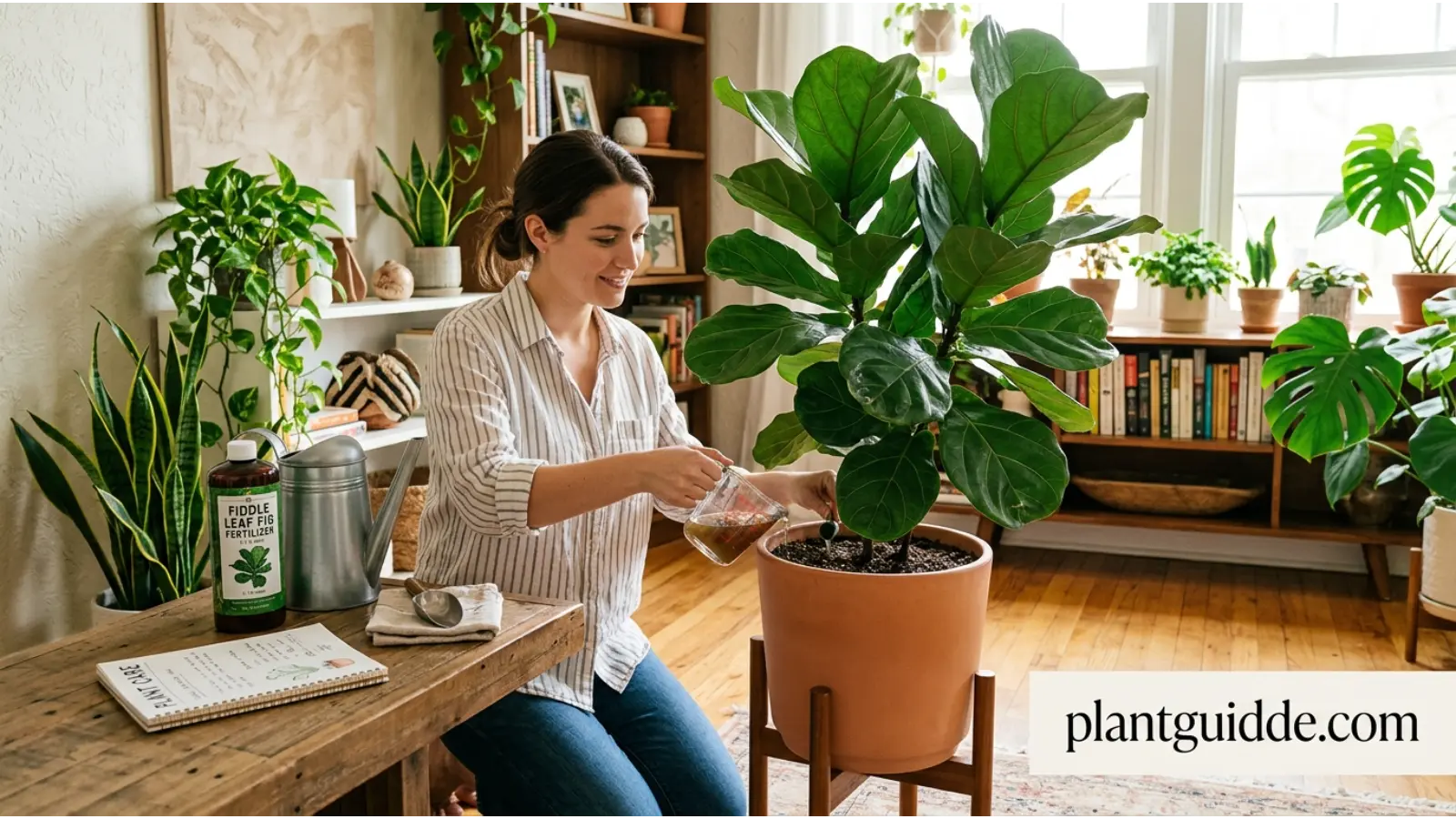
A fiddle leaf fig uses nutrients to produce new leaves and maintain vigorous growth.
During active growth, a balanced houseplant fertilizer or an appropriate fertilizer formulated for foliage plants can be useful. RHS notes that a high-nitrogen fertilizer can be used from spring through late summer to encourage leafy growth in ornamental figs.
Follow the fertilizer label rather than assuming more fertilizer means faster growth.
Overfertilizing can lead to salt accumulation in the growing medium and damage roots.
If your plant is growing very slowly because it has inadequate light, adding more fertilizer will not solve the underlying problem. Correct the environmental limitation first.
How to Repot a Fiddle Leaf Fig
Repotting is usually necessary when the root system has substantially filled the existing container or the soil has deteriorated.
RHS recommends moving ornamental figs into a slightly larger container every couple of years in spring, with fresh growing medium.
Signs your plant may need repotting
Look for:
- Roots emerging from drainage holes
- Roots tightly circling the inside of the pot
- Water running through the pot unusually quickly
- Severely compacted or degraded soil
- Growth slowing despite suitable light and care
Do not repot simply because the plant is tall.
A tall fiddle leaf fig can still be perfectly comfortable in its existing container if the roots and soil are healthy.
How to Prune a Fiddle Leaf Fig
Pruning can help control height, improve shape, and encourage branching.
If your fiddle leaf fig has one tall central stem and you want a fuller appearance, strategic pruning during active growth can encourage new shoots below the cut.
Before pruning:
- Use clean, sharp pruning shears.
- Decide where you want new growth to develop.
- Avoid removing large amounts of healthy foliage at once.
- Make deliberate cuts rather than repeatedly trimming small sections.
Pruning is also useful when the plant has outgrown its available space.
Remember that pruning changes the plant’s structure, so it is better to plan the desired shape before making major cuts.
How to Clean Fiddle Leaf Fig Leaves
Large fiddle leaf fig leaves collect dust easily.
Dust can make the foliage look dull and can interfere with the plant’s ability to use light efficiently.
Every few weeks, gently wipe the leaves with a clean, damp cloth. Support the leaf underneath while cleaning to avoid bending or tearing it.
Avoid using household cleaning products, oils, or leaf-shine products unless they are specifically designed and proven safe for plant foliage.
Clean leaves also make it easier to spot pests early.
Image Suggestion: A close-up care guide showing a fiddle leaf fig’s large leaves being gently cleaned with a damp microfiber cloth, with healthy glossy foliage beside dusty foliage.
Why Is My Fiddle Leaf Fig Dropping Leaves?
Leaf drop is one of the most frustrating fiddle leaf fig problems.
It does not automatically mean the plant is dying.
Possible causes include:
- Sudden changes in light
- Moving the plant
- Overwatering
- Excessive drying
- Temperature fluctuations
- Cold drafts
- Root problems
- Pest infestations
- Significant changes in the surrounding environment
Research and extension guidance on related Ficus species also emphasizes that abrupt environmental changes and watering extremes can trigger leaf drop.
If your plant recently moved from a bright nursery or greenhouse into a darker home, it may need time to adjust.
The most useful response is to examine recent changes rather than immediately adding more water or fertilizer.
Fiddle Leaf Fig Leaves Turning Brown
Brown leaves or brown edges can have several causes.
Brown, crispy edges
These commonly occur when the plant experiences excessive dryness, inconsistent watering, or very dry indoor air.
Check:
- Whether the soil is becoming excessively dry.
- Whether the plant is near a heating or cooling vent.
- Whether humidity is extremely low.
- Whether roots are actually healthy enough to absorb water.
Brown spots with consistently wet soil
When brown areas occur while the soil remains wet for long periods, investigate the roots and drainage rather than simply watering more.
Check whether:
- The pot has drainage holes.
- The soil is compacted.
- The decorative container is holding water.
- The plant is sitting in a saucer of standing water.
Why Are Fiddle Leaf Fig Leaves Turning Yellow?
Yellow leaves can result from several different problems, so the pattern matters.
If older leaves gradually yellow while the soil stays wet for extended periods, excessive moisture or poor root conditions deserve attention.
If the plant is yellowing while also growing slowly in a dim location, insufficient light may be contributing.
Do not diagnose the problem from leaf color alone.
Ask:
What has changed in the plant’s environment?
Check light, soil moisture, drainage, temperature, and recent watering history before making a major correction.
Why Are Fiddle Leaf Fig Leaves Curling?
Curling can occur when the plant is experiencing water stress or unfavorable environmental conditions.
Check for:
- Very dry soil
- Excessively wet soil
- Low humidity
- Hot air from vents
- Cold drafts
- Sudden changes in light
If the soil is dry, water thoroughly and then monitor how quickly it dries.
If the soil is constantly wet, do not respond by watering again. Investigate drainage and root health first.
Why Is My Fiddle Leaf Fig Not Growing?
Slow growth does not always mean the plant needs fertilizer.
The first thing to evaluate is light.
A fiddle leaf fig needs enough light to support active photosynthesis and new growth. If it is positioned deep inside a room, moving it closer to a bright window may make a greater difference than increasing fertilizer.
Also check:
- Root crowding
- Poor-quality or compacted soil
- Seasonal changes
- Inconsistent watering
- Temperature stress
- Pest activity
Growth naturally slows when conditions are less favorable, particularly during darker parts of the year.
Common Fiddle Leaf Fig Care Mistakes
1. Watering on a fixed schedule
The plant’s needs change throughout the year. Check the soil instead.
2. Keeping the soil constantly wet
Fiddle leaf figs need moisture, but their roots also need oxygen. Well-drained soil is essential.
3. Putting the plant in a dark corner
A beautiful decorative location is not necessarily a suitable growing location.
4. Moving it repeatedly
Fiddle leaf figs can respond poorly to sudden changes in light and environment. Give the plant time to acclimate.
5. Using an oversized pot
More soil means more moisture retention. A pot that is much larger than the root system can make watering harder to manage.
6. Fertilizing a stressed plant aggressively
Fertilizer cannot compensate for poor light, root problems, or improper watering.
7. Ignoring pests
Large leaves provide plenty of surface area for pests such as spider mites, scale, thrips, and mealybugs. RHS identifies these as potential pests of Ficus lyrata grown under glass.
How to Check Your Fiddle Leaf Fig for Pests
Inspect both the upper and lower surfaces of leaves.
Look for:
- Fine webbing
- Tiny moving insects
- Sticky residue
- Cottony clusters
- Small brown or scale-like bumps
- Speckled or stippled foliage
- Distorted new growth
If you find pests early, isolate the affected plant from other houseplants and identify the pest before selecting a treatment.
Regular inspection is easier than trying to rescue a severe infestation later.
Fiddle Leaf Fig Care Through the Seasons
Spring
As light levels increase, growth often becomes more active.
This is a useful time to:
- Assess whether the plant needs repotting.
- Begin or increase feeding according to the fertilizer instructions.
- Prune if necessary.
- Check for pests.
- Gradually increase watering as the plant’s soil dries faster.
Summer
Bright light and warm temperatures can increase water use.
Check the soil more frequently rather than automatically increasing watering frequency. Plants near hot windows can dry faster than plants in cooler parts of the room.
Fall
As daylight decreases, the plant may use water more slowly.
Do not continue watering at the same frequency simply because that was appropriate during summer.
Winter
Indoor heating can produce dry air while lower light reduces water consumption.
Be especially careful not to compensate for dry air by keeping the soil constantly wet.
RHS recommends keeping ornamental figs only just moist during winter and protecting them from temperature fluctuations and drafts.
Can You Grow a Fiddle Leaf Fig Outdoors?
In suitable warm climates, fiddle leaf figs can be grown outdoors, but an indoor plant should not be moved directly from a sheltered room into intense outdoor sunlight.
Acclimate it gradually.
RHS lists Ficus lyrata as a tender plant and recommends sheltered growing conditions.
Outdoor conditions also introduce additional variables, including stronger sunlight, wind, temperature changes, rain, and pests.
If nighttime temperatures are unsuitable, bring the plant back indoors or provide appropriate protection.
How to Make a Fiddle Leaf Fig Fuller
A naturally upright fiddle leaf fig can sometimes become sparse, particularly when light reaches the plant unevenly.
For a fuller appearance:
- Give the plant strong, consistent light.
- Rotate it periodically if one side receives much more light.
- Prune strategically when appropriate.
- Avoid cutting away excessive foliage at once.
- Give new shoots adequate light as they develop.
Pruning alone cannot compensate for poor lighting. If the plant is continually stretching toward a window, address the light first.
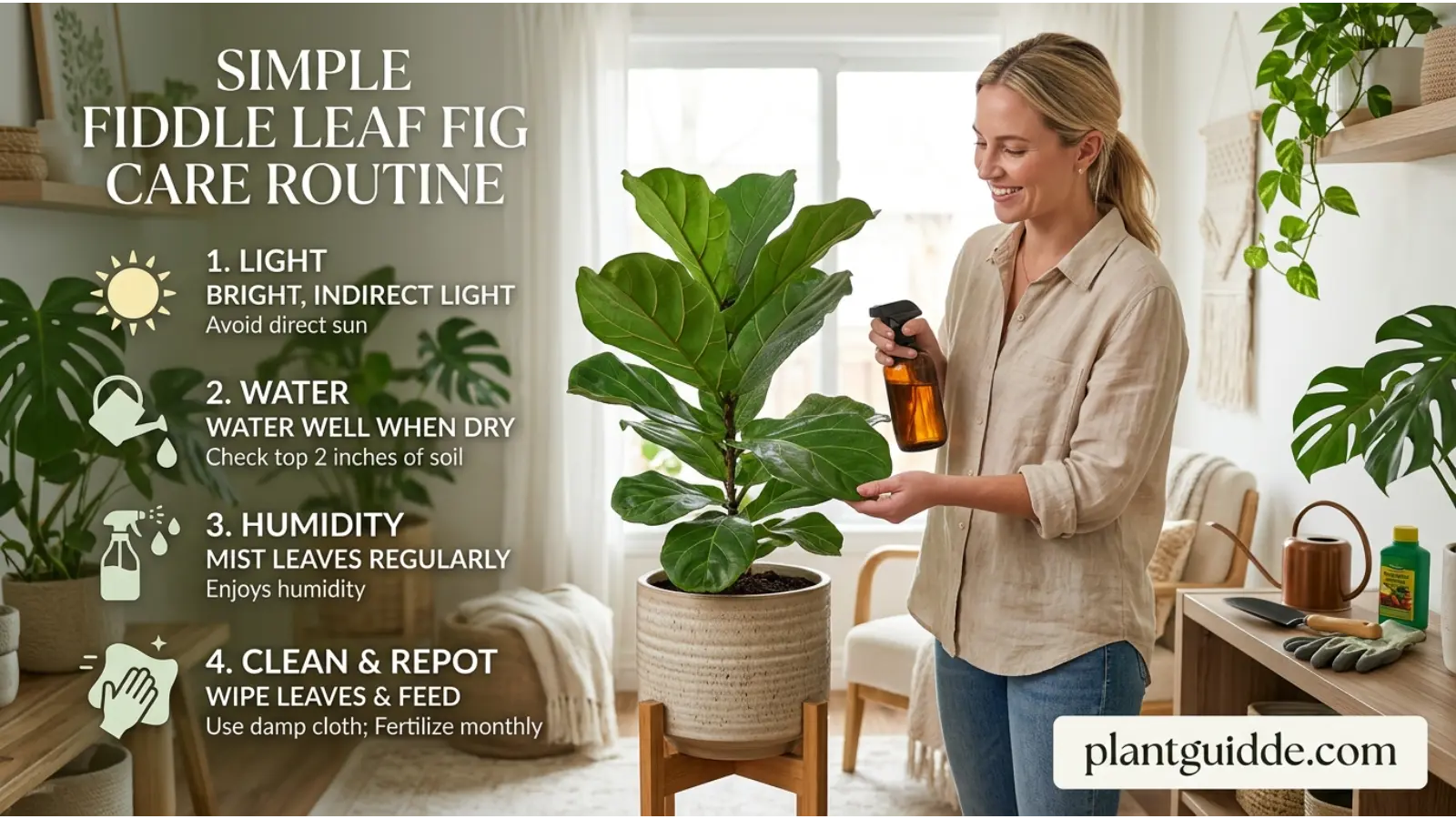
A Simple Fiddle Leaf Fig Care Routine
You do not need to constantly fuss over the plant.
Weekly
- Inspect the leaves.
- Check the soil moisture.
- Look for pests.
- Check whether the plant is receiving consistent light.
Every few weeks
- Clean dusty leaves.
- Inspect the undersides of foliage.
- Rotate the plant if needed.
- Check the drainage area for standing water or salt buildup.
During active growth
- Fertilize according to the product instructions.
- Monitor new growth.
- Adjust watering as the plant’s water use changes.
Every year
- Evaluate the plant’s size and shape.
- Check the condition of the soil.
- Decide whether pruning or repotting is actually necessary.
The goal is not to create a complicated schedule. It is to notice changes early and respond to the actual condition of the plant.
FAQs:
How often should you water a fiddle leaf fig?
Water when the appropriate upper portion of the soil has dried rather than following a fixed calendar. When watering, soak the soil thoroughly enough for excess water to drain, then empty standing water from the saucer or cachepot.
Do fiddle leaf figs need direct sunlight?
They need strong light and can tolerate some direct sun, but a plant accustomed to lower indoor light should be acclimated gradually before receiving intense direct sunlight. A bright window is usually a better starting point than suddenly placing the plant outdoors in full sun.
Why are the leaves on my fiddle leaf fig turning brown?
Brown edges can be associated with inconsistent moisture, excessive dryness, dry air, or environmental stress. Brown areas combined with persistently wet soil should also prompt you to check drainage and root conditions.
Should I mist my fiddle leaf fig?
Misting can temporarily increase humidity around the foliage, and RHS recommends it as one option for ornamental figs. However, consistent room humidity, appropriate watering, and protection from drafts are more important than relying on misting alone.
How do I make my fiddle leaf fig grow new leaves?
Start with light. Give the plant a bright, stable location, maintain appropriate soil moisture, provide adequate nutrition during active growth, and avoid repeated environmental changes. If roots are crowded or the soil has deteriorated, repotting may also help.
Final Thoughts
Successful fiddle leaf fig plant care is less about following a rigid schedule and more about creating stable conditions.
Give the plant plenty of appropriate light, let the soil dry sufficiently between thorough waterings, use a well-draining growing medium, maintain warm and reasonably humid conditions, and avoid sudden environmental changes.
When something goes wrong, resist the urge to immediately water, fertilize, or move the plant. First look at the pattern: light, soil moisture, drainage, roots, temperature, and recent changes. That simple troubleshooting habit can prevent many common fiddle leaf fig problems before they become serious.